
SubX.News® Population Report
72% of Chicago residents are not Black
79% are U.S. born (2025 Census estimate)
Approximately 2.73 million residents
Chicago’s largest long-term demographic decline has been the loss of Black residents, a trend often referred to as Black Flight.
The city’s Black population peaked in 1980 at 1,187,905 residents, representing nearly 40% of Chicago’s population.
According to the latest U.S. Census estimates, Chicago’s Black population is now approximately 760,000 residents, a decline of more than 425,000 people since its peak.
The decline has reshaped Chicago’s demographics. Black residents accounted for nearly 40% of the city’s population in 1980. Today they account for approximately 28%.
The largest population losses have occurred on Chicago’s South and West Sides, particularly in neighborhoods including Englewood, West Englewood, Auburn Gresham, Roseland, Greater Grand Crossing, Washington Park, North Lawndale, and Austin.
Historical vs. Modern Loss
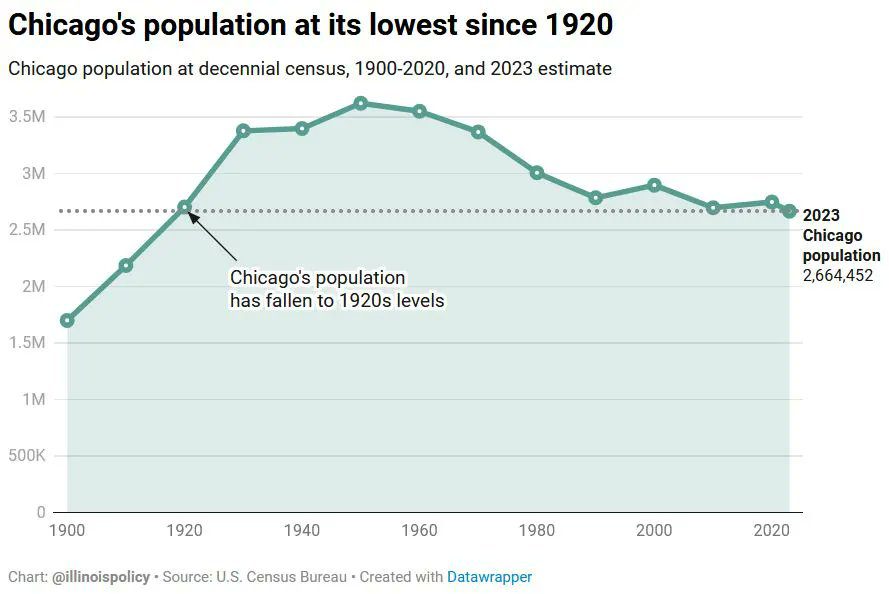
Chicago’s overall population declined dramatically between 1950 and 1990 as suburbanization and White Flight reduced the city’s population from nearly 3.6 million residents to approximately 2.7 million.
In recent decades, the largest share of Chicago’s domestic population decline has come from the continued loss of Black residents, while international immigration has helped stabilize the city’s overall population.
Primary Driving Factors
Research from institutions like the Great Cities Institute points to a combination of systemic factors causing residents to leave:
- Historic segregation and decades of disinvestment on the South and West Sides
- Concerns over violent crime and public safety
- Limited employment opportunities and neighborhood economic decline
- School closures and disparities in educational opportunities
- Rising housing costs, property taxes, and rent inflation
Researchers conclude that no single factor explains the migration. Rather, it reflects the combined effect of long-term structural and economic conditions.
Where Residents Are Moving
While Chicago’s total city-limit population numbers are currently stabilizing due to international migration, domestic families are trading the dense urban core for more affordable space.
Communities including Plainfield, Lockport, and Kendall County have experienced some of the fastest population growth in northeastern Illinois, with some areas growing by more than 10%.
Residents are also relocating out-of-state to Northwest Indiana and booming Southern metros like Atlanta, Dallas, and Houston.
The Fiscal Impact
As domestic population loss continues, the city’s long-term financial obligations are spread across fewer residents, increasing the fiscal burden on those who remain.
According to the Great Cities Institute, Chicago carries approximately $36 billion in unfunded pension liabilities resulting from decades of pension underfunding.
When evaluated against peer cities, Chicago’s long-term liabilities equal 430.3% of annual governmental revenues, compared with 217.3% for Detroit, 241.7% for Milwaukee, and 107.3% for Philadelphia.
Benchmarking data shows that 16.8% of Chicago’s population currently lives below the poverty line.
The report also found that approximately 80% of Chicago’s Corporate Fund is committed to relatively fixed expenditures.
Those costs include public safety (45%) and pensions and debt service (35%).
As a result, the city has comparatively little budget flexibility for neighborhood investment and other discretionary services.
Chicago’s population story is no longer defined by overall decline, but by who is leaving and who is replacing them.
Part One examined who is leaving Chicago. Part Two will examine who is replacing them, and how those new residents are reshaping the city’s economy, neighborhoods, and future.
Sources
Final Report: Options for Chicago’s Financial Future
Posted on July 15, 2026 https://greatcities.uic.edu/news-stories/final-report-options-for-chicagos-financial-future/
Chicago population hits lowest point since 1920
August 10, 2024 by Barrington Hills Observer
https://barringtonhillsobserver.com/2024/08/10/chicago-population-hits-lowest-point-since-1920/
Chicago’s Density in 2020 by Pete Saunders 06/22/2022 https://newgeography.com/content/007491-chicagos-density-2020
Fact Sheet: Black Population Loss in Chicago
https://greatcities.uic.edu/wp-content/uploads/sites/942/2025/08/Black-Population-Loss-in-Chicago.pdf
Chicago Tops Nation in Population Loss for Second Straight Year May 25, 2017 https://news.wttw.com/2017/05/25/chicago-tops-nation-population-loss-second-straight-year
