
Amateur Hour City Contracting and Liberal Policing Keep Taxpayer Dollars Flowing to the Wrong People SubX.News®
It’s a few minutes before six in the morning, Friday, July 24, 2026.
I’m on my bike in McKinley Park. I didn’t stretch. I should’ve stretched.
As you get older, you figure out you can’t just jump into exercise.
You’ve got to get the blood moving in the joints first or you’re going to feel it later.
Weather’s nice. Little nicer now.
People yell “global warming” like it just means hot or cold. Global warming is about the swings, the changes.
Yes, it’s getting warmer, but that’s happened before. If you don’t get that, go down to the Field Museum, the one named after Marshall Field, the capitalist.
They’ve got that exhibit that walks through the history of the Earth. You see the evolution, the climate shifts, the built environments, all of it.
Used to ride my bike every day for three, four years straight.
Before that I rode the CTA almost ten years. Red Line at midnight, one in the morning. Blue Line, Orange Line, same thing.
I’ve seen this city at hours most people sleep.
Today I’m looking at one thing: a faucet in McKinley Park and the concrete around it.
Thirty years I’ve been drinking out of that faucet.
Every day.
I’ve lived in this neighborhood that long.
They took it out because of the lead pipes. That’s fine.
They put in new stainless faucets around here. Water tastes better.
Doesn’t taste like lead anymore.
But this one? Over here?
Six months.
Over six months and they still can’t put a faucet in.
Six months.
Let me show you.
We roll up and there it is. You see that pad?
This is supposed to be a park.
Old people walk here, young people, kids, everybody.
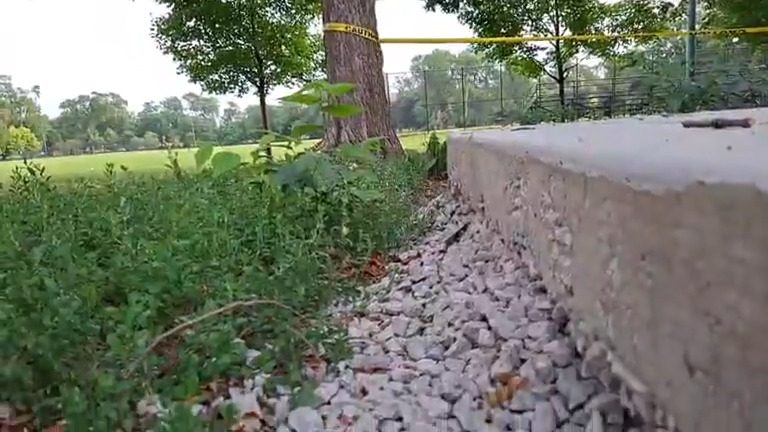
Look at that ledge. You see that there? That’s almost a two‑foot drop in some spots.
You’re walking, you’re talking, you’re not staring at your feet, you hit that, you’re gone.
And someone will say, “Oh, John, you’ve got to pay attention.” No.
That’s not how a built environment works.
A good built environment assumes people don’t want to break their necks.
This guy left ledges like it’s a construction zone in his backyard. This is a public park. Open site.
No tape. No fill. Nothing.
That’s incompetence.
That’s dangerous.
That’s what you call a bad contractor.
That’s what you call a bad supervisor.
That’s how you read your city from one concrete job.
Now look at the concrete itself.
See that white? It’s too white. Too much lime. That tells you they wanted it to dry faster.
When you do that, it’s brittle.
You see the gravel already coming out?
The holes already forming? You shouldn’t pull the forms and leave it like that. You backfill before you take the boards out so nothing moves.
This guy didn’t do that.
You see the edge? It’s rough.
You see the little ledges and gaps? Water gets in there, freezes in the winter, and this is all going to crack.
Concrete like this should last 50 to 75 years. This won’t. This is going to start failing apart in a few years, maybe sooner.
I’ve seen other jobs just like it.
Up by Foster Beach at the gates to the parking lot?
Same thing. Bad concrete, bad work.
Now look at these caps. Let me sit down and show you.
See that there?
I’m sitting on the shut‑off cap.
There’s another one right next to it.
He’s got, what, three caps in this little area?
These are shut‑offs. That means he cut the pipe here, put a shut‑off, cut it there, put another one, and poured around it.
Lazy. You can tell there’s a pipe running under this whole thing so instead of doing the job right, he just chopped and capped.
Look at the height. From the ground to the top of his edge, he’s about 12 inches up. A full foot above grade.
You see that? Ground is here, his work is up here.
What are you going to do now, build up all the grass 12 inches around it?
You going to raise the whole park?
Or just leave it like that and hope nobody falls?
That’s how you know he doesn’t know how to use a tape measure. That’s how you know whoever designed or signed off on this didn’t think about people actually walking here.
This is amateur hour.
This is extremely poor workmanship.
This is dangerous.
A normal city, the park supervisor red tags this.
They call the inspector.
Inspector comes out, says no way.
Contractor loses the license, refunds the money, and they tear this all out and start over. That’s what should happen. This is a little faucet, but it should last half a century.
Instead, they turned it into a trip hazard.
Now, you say, “John, why are you bothering the guy? He’s working. You’re anti‑worker.”
No. I’m anti‑scam.
There’s a difference.
Real workers don’t leave a 12‑inch ledge in a park and call it a day.
Real workers don’t pour lime-heavy concrete and walk away with loose gravel and holes in the edges.
This isn’t about a guy with a shovel trying to feed his family.
This is about who gets the contract, who gets away with garbage, who keeps getting checks from the city.
You’re looking at crony work. This is a crony who gets a job through the Brandon Johnson crowd or the park district machine.
He wants to get elected, they want to stay in good standing, and this is what you get: a park hazard next to a faucet people used for 30 years.
That’s one little microcosm of the whole city.
Lift your head up for a second and look around.
We’re in McKinley Park. This park was built over 100 years ago. Look how nice it is.
You see that there? Heron comes in and lands on the tree. Another one flies in.
Geese over there.
Ducks over there.
There’s clams, there’s fish, all kinds of wildlife in this lagoon.
They once found a head in here, a murder victim.
They drained the whole thing.
I don’t even know if they ever identified that person.
This park has seen everything: beauty, murder, families, crime, peace.
And it still stands.
The old park holds up. The new work is what’s failing.
I start rolling again and I’ve got fishing line on me. Somebody’s been fishing and just throws their line down.
Plastic bags, lines in the water.
People feed the geese and leave the plastic. Goose eats the plastic, chokes, dies.
That’s the kind of little thing you see when you ride or walk.
People say they love nature, then they leave a bag that kills it.
And while I’m out here looking at faucets and geese and bad concrete, I’m also checking where we are on the bigger stuff.
I was banned from Twitter for 24 hours because I put up pictures from the Hunter Biden laptop.
Instagram sends me a warning: do it again and we’ll deactivate your account.
Facebook already shut one of my accounts down after 15 years, millions of hours of activism, because I posted pictures of people protesting President Biden in Maui after the fires.
They didn’t like that.
My wife asks, “Why did you do that?” I say, because I like to check where I’m at. You want to see if the deep state is still there? It’s still there. You put up something they don’t like, you’re gone.
Meanwhile, the guy who poured this crooked concrete and left a 12‑inch drop-off?
No ban. No warning. He gets paid.
Riding gives me time to think.
One thing reminds you of another.
Later in the ride, I’m thinking about a video out of Madison or Milwaukee.
Some bike thief, they say. Cops chase him, knock him off his bike. He’s got a knife, stabs a cop or comes at him.
Cops shoot him. He’s dead now.
People ask, “Where’s the body cam?”
Good question.
Here’s the answer:
Madison is ultra‑liberal. Everybody knows Antifa comes out of there. Antifa training ground.
They don’t want body cams on cops because then you’d see how much crime there is and who’s doing it.
One person online said it straight: Madison’s liberals voted against body cams because body cams would justify more policing.
They don’t want that on record.
In Chicago, we do have body cams, but they’re used different. Here, body cams and COPA are used against the police.
COPA is an anti‑police operation.
It goes after cops to destabilize the city, to make it easier for criminal activity to run wild.
That helps gentrification.
Crime drives people out, property values shift, land opens up, and guess who steps in?
The same kind of contractors who did this park job. They get more work, more money, more chances to pour bad concrete.
You might say, “John, you’re making big jumps there — from body cams to concrete to gentrification.”
No. It’s the same logic.
Same people. Same network.
No standards. No accountability.
You can see it in a crooked concrete job.
You can see it in the city’s overnight crime reports.
Every morning tells a story if you’re willing to look.
Overnight Violence
While Chicago slept, violence spread from Hyde Park to Uptown as five people were killed and four others were wounded in shootings over roughly six hours Thursday evening into early Friday.
Among the victims was a 13-year-old boy, while police also investigated a stabbing in Humboldt Park.
The first fatal shooting occurred about 5:35 p.m. in the 5900 block of South Ellis Avenue in Hyde Park, where officers found a 27-year-old woman and a 24-year-old man inside a vehicle, both suffering gunshot wounds to the head.
Both later died at the University of Chicago Medical Center.
About an hour later, gunfire erupted in the 3800 block of West Adams Street in West Garfield Park. A 49-year-old man, later identified as James Gooden, was fatally shot in the head while a 13-year-old boy inside a nearby vehicle suffered a gunshot wound to the foot and was hospitalized in good condition.
The violence continued throughout the night. A 36-year-old man was shot while sitting in a parked vehicle in South Shore. A 26-year-old man was shot in the back during a fight in South Austin.
Around 11:12 p.m., another shooting in Hyde Park left a 25-year-old man dead and a 25-year-old woman wounded after someone fired into their parked vehicle.
Shortly after midnight, a 21-year-old man sitting inside his vehicle in Uptown was shot in the neck and later died at Illinois Masonic Medical Center.
Police also responded to a stabbing in the 1000 block of North Hamlin Avenue in Humboldt Park, where a 33-year-old man was found with cuts and transported to Stroger Hospital in good condition.
Area detectives continue investigating each of the incidents.
Different locations.
Different victims.
Different investigations.
But the question keeps coming back to the same place, they’re all telling the same story.
Crime here, bad construction there, contracts in the middle.
Same city.
Think back to what your mom or grandma used to say.
She’d look at somebody and say, “I don’t like them. I don’t want you around them.”
And you’d say, “But you didn’t even talk to them.”
And she’d say, “I don’t need to talk to them. I just look at them.”
Your dad might say the same thing.
They trusted their gut.
We got away from that.
Now you’re told you can’t judge anything until a think tank writes a report.
You can’t say this concrete is wrong, this faucet is wrong, this contract smells wrong, this “reform” doesn’t make sense.
If you do, you’re anti‑this, anti‑that.
Go with your instincts. Get out of your house.
Don’t let fear of carjackers, murderers, rapists, and mayhem lock you inside.
Yes, those things exist.
But if you don’t walk, don’t ride, don’t drive, don’t read, don’t watch real videos that show real things, you’ll never see the ripoff.
You’ll miss the 12‑inch mistake staring you in the face.
Life is crooked, but the safest route is still to look, measure, and call out what doesn’t line up.
One faucet. One slab of bad concrete.
One park that’s over 100 years old.
That’s enough to tell you the state of your city.
Be careful. It might rain a little. Be safe.
I love riding my bike.
Bye.
—-
Progressive Concrete and Body Cams … Friday morning bike ride 555am July 24th 2026 https://youtu.be/PG-7PuTflEo
