
SubX.News® Street Report – June 18, 2026
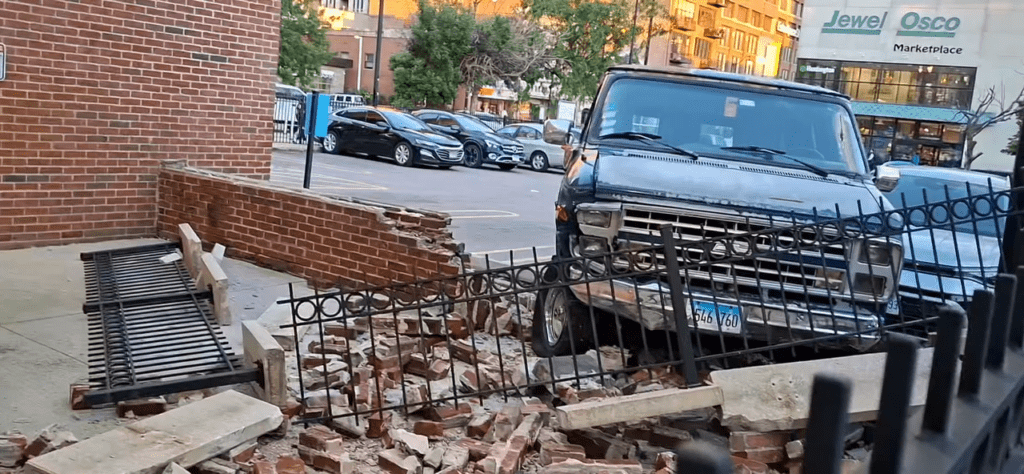
On the night an old Chevy van plowed into a brick wall in a Jewel Osco parking lot that everybody on the street already knows as a dope spot, Chicago’s leaders were busy selling a different story.
Legacy museums, stadium deals, and “intervention” money.
Cameras downtown caught the speeches.
Bricks at Roosevelt and Wabash caught the truth.
It was 8:08 p.m. in the Jewel Osco lot at Roosevelt and Wabash, the tail end of a hot June day. A beat-up Chevy van came in too fast, clipped another car, and drove straight into the brick wall hard enough to bring it down.
Shoppers froze where they stood. An ambulance pulled in under the sodium lights. Cameras rolled in a space that doubles daily as a supermarket parking lot and an open-air drug market.
Roosevelt–Wabash lot isn’t just a place to park.
It’s part of a small, well‑known ecosystem: dope moving in the open, regular disturbances, people hustling because they know no one is really coming to shut it down.
In late 2025, a weeks‑long undercover investigation by the Cook County Sheriff’s Office led to a major drug bust in the South Loop, targeting open‑air cannabis dealing near Roosevelt and Wabash.
Undercover officers ran multiple buys in the area before moving in, arresting seven people and filing 11 felony counts of manufacture and delivery.
They try, but it keeps coming back.
When something goes wrong in a lot like that, it doesn’t go wrong politely. It goes wrong at speed, in metal, glass, and brick.
Earlier that evening, several miles away on the West Side, the picture did not look much different.
Four years on these blocks have shown, the same corners, the same faces, the same deals.
Cops, Hookers, and the Motion to Dismiss
Later that same outing, the picture moved from conference rooms to corners.
State police on Lexington brought another layer of authority into the frame. State troopers in the area, lights up, a visible show of force.
Around them, the same street economy ran its loops: dealing, hanging, moving, watching.
Different patches on the shoulders, same pattern underneath.
On Fifth Avenue, marked squads sat on the block while the sex trade and street hustle carried on in front of them.
Cops and hookers on 5th was not a slogan, it was a description: uniforms parked on the same stretch as visible sex work and open transactions.
The message to the block was simple, police present, enforcement absent.
Not all of the fight was on the sidewalk.
A motion to dismiss was prepared and taken to court, but it didn’t go in. Instead of going on the record, it stalled in badges, hiding, and excuses.
On paper, there is always a process. In practice, the system can keep a case alive just by refusing to let the challenge hit the file.
Outside, sirens and scanner calls kept stacking.
On the record, officials talked procedure.
On the street, nothing changed.
Oak Park Green Line Harlem functions as a heavy‑use zone for open drug markets, boosting and whatever else it takes to make a score.
It’s not hidden crime; it is sidewalk infrastructure.
No consultant report is needed to see it, only a pair of shoes and the willingness to stand there.
On paper, the city has poured roughly $5 million of “crime intervention” money into these neighborhoods and the county has announced $20 million more just for this year.
On the street, those dollars are invisible.
Dealers haven’t moved.
Women are still working the same stretches.
Gunshots and stabbings still cut through the scanner traffic like they always have.
Violence prevention is political currency for Brandon Johnson’s operation, money routed through nonprofits and contractors to secure loyalty while the bodies and the fear stay put.
If the programs were working, you wouldn’t need a press conference to prove it. You’d measure success in days without a murder, days without a shooting, and blocks where kids can walk without sidestepping dealers.
Right now, those days are rare enough to count on one hand.
Across town, the official storyline was running on a different track entirely.
Dedication of the Obama Presidential Center led the headlines. Former President Barack Obama stood in front of a carefully arranged crowd and talked about democracy and civic duty.
The center promises a museum, an athletic facility, a library, a vegetable garden, and a playground, a full campus of branded hope and history on the South Side, built to anchor a certain image of the city.
Big‑name performances by Stevie Wonder and Bruce Springsteen turned the opening into a national media event.
At the same time, Mayor Brandon Johnson was pushing a $420 million public package to support a privately financed soccer stadium, a massive commitment of taxpayer support in a city that struggles to keep basic services running and housing safe.
National and regional noise framed it all: flash flood emergencies and severe weather along the Gulf Coast, sanctions lifted under the Iran nuclear deal reshaping oil markets, and gas prices in the region finally dipping under four dollars a gallon.
In Joliet, a $2 million settlement over overweight truck ticketing showed another local government backing off only after the courts step in.
From Washington to Springfield to City Hall, the language is always “investment,” “resilience,” and “intervention.”
On the scanner, it’s still shots fired, fights in progress, and another ambulance rolling out.
On paper, Chicago is investing in democracy, culture, and safety.
On the sidewalk, it’s the same script: murders in Uptown, a traffic‑stop shooting in Brighton Park, kids brawling in Foster Park, dope moving in the open from the West Side into Oak Park and back again.
The distance between the press release and the parking lot is the real gap this city refuses to measure.
Which brings it back to that brick wall at Roosevelt and Wabash.
One van, one hit, one wall taken out in a lot everybody already knows as a drug corner. An old Chevy comes in too fast, clips a car, and buries itself in the brick while the ambulance lights wash over a supermarket that doubles as a market for everything else.
This is the part of the city the speeches never quite reach, the part where policy turns into damage, where the “interventions” are invisible and the only thing residents can count on is that no one in power will show up until after the sirens stop.
In the end, that’s the real record of June 18, 2026.
Not the ribbon cuttings, the stadium plans, or the carefully scripted statements about democracy.
It’s the corners where people actually live and die.
Parking lots that function as markets and crash zones.
Streets that run on their own rules because the city no longer enforces its own.
Walls smashed, bricks flying—the street is in charge of the city.
——-
Image Van crashes through brick wall over at Roosevelt Wabash Jewel Osco South Loop happened about 730pm June 18 2026 SubX.News®
Editor’s Note: This report is based on a live video drive, broadcast radio traffic, and independent police scanner feeds.
Good Morning Sunrise 5:15 AM in Chicago Thursday, June 18, 2026 https://youtube.com/shorts/HzAC_WOmXcw
Tent Cities for Developers, Chaos for Everyone Else: Inside Chicago’s Two-Tier Cleanup Strategy Chicago economy crime and migrant update 4pm June 18th 2026 https://youtu.be/VYURWCiCLJU
Drugs, Fly-Dumping, and a Murder the News Skips Westside Chicago 6pm June 18 2026 https://youtu.be/8mQ8e50JNhE
Thursday Night Out 730pm Jun 18 2026 https://youtube.com/shorts/k3eqWiwG17s
Old Chevy van smashed into the brick wall 8pm Jun 18 2026 https://youtube.com/shorts/xrosWoYAenc
Van crashes through brick wall 819pm Jun 16 2026 https://youtu.be/FDxRseQ8FRs
Chicago Sunset 828pm Jun 18 2026 https://youtu.be/xEZStvf7Ye8
http://SubX.News® On the Spot Reporting
