
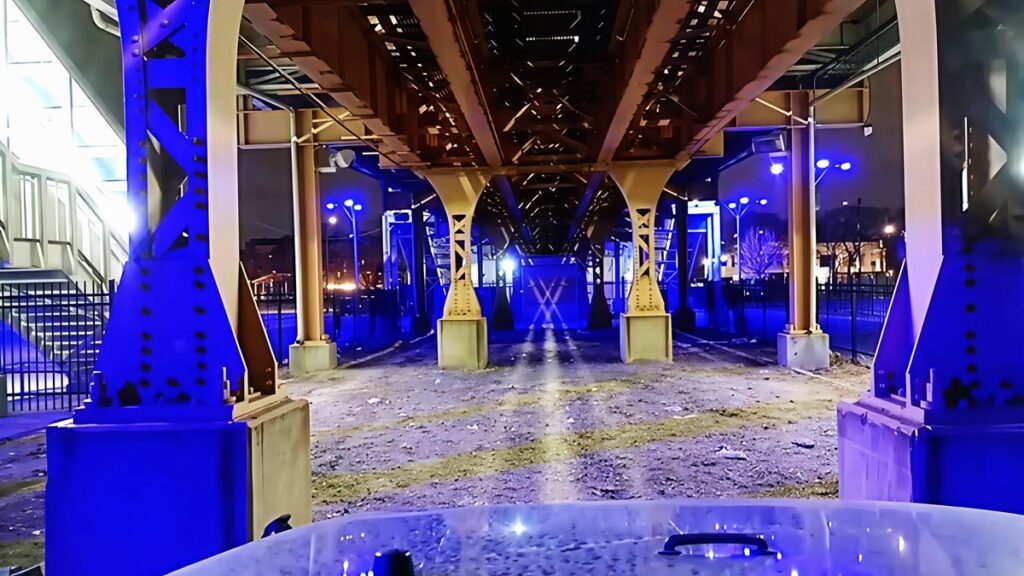
Lakefront guns, empty storefronts, boarded South Side buildings, and a city that does not add up while others cash in.
Street Report | Feb 20, 2026
Soundbed started on the AM dial at 4pm.
WBBM led with the U.S. Supreme Court’s decision striking down President Trump’s global tariff regime, ruling he had gone too far by using emergency powers to tax nearly everything coming into the country.
Trump responded by attacking the Court, including justices he himself had appointed, and promising to reimpose tariffs through different laws, with a new flat ten percent tariff on imports.
Across Illinois, Governor JB Pritzker seized the ruling to demand payback. From a stop in Oak Park he claimed the tariffs had cost each U.S. family around two thousand dollars and Illinois families about one thousand seven hundred each.
Out in Vernon Hills, Learning Resources, a family owned toy company that had helped bring the legal challenge, said the decision might finally return the fourteen million dollars they had paid in duties.
While billionaires argued about our checks, the drive north along Michigan Avenue told a quieter story.
In the Gold Coast, the numbers changed but the questions did not.
Around Elm Street and Rush, the phone filled with Zillow estimates, 2,000,000 dollar homes lined up along quiet, leafy streets.
It was hard not to hear the talk of 4‑figure refunds on the radio and think about those price tags.
In one part of town, billionaires were fighting over who deserved credit for a $1,700 check. In another part, that same amount barely covered a few months of property taxes.
Downtown retail sat in an in between place, part recovery, part hollowed out.
Brokers say Mag Mile and Loop vacancies peaked near 30% after the pandemic and have started to inch down, but driving it on this Friday, it still felt half hollowed out, with too many windows still dark.
Somewhere between those extremes, the math of the city did not quite pencil out.
Michigan Avenue vacancies made it clearer.
840 North Michigan carried a blunt message, entire building for lease, plastered with giant QR codes like some cheap cell phone gimmick.

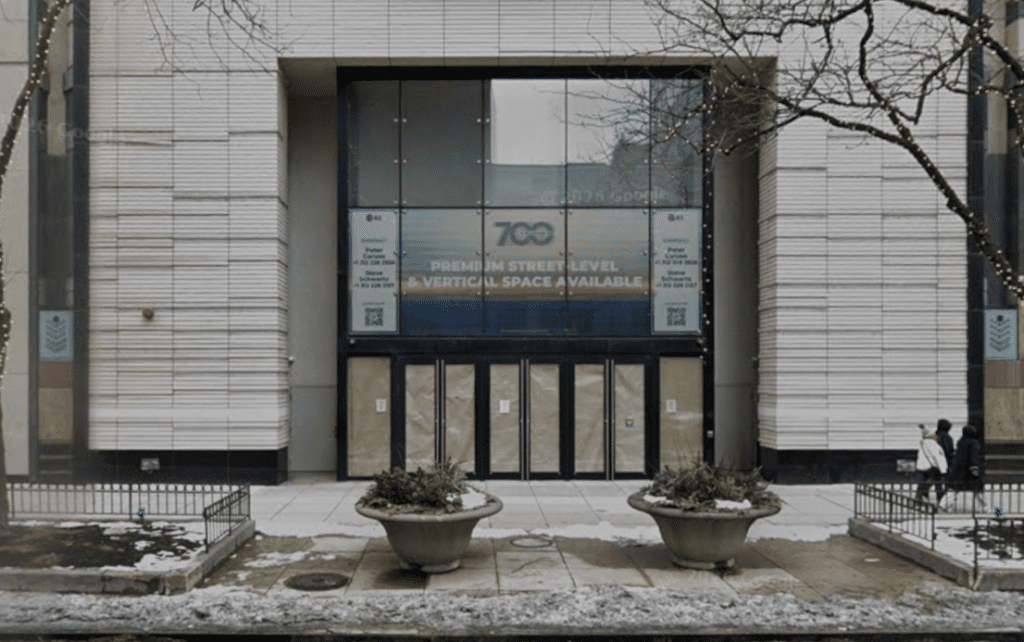
700 North Michigan had the same look, doors papered, signage promising premium space available, no life behind the glass, just another leasing pitch.
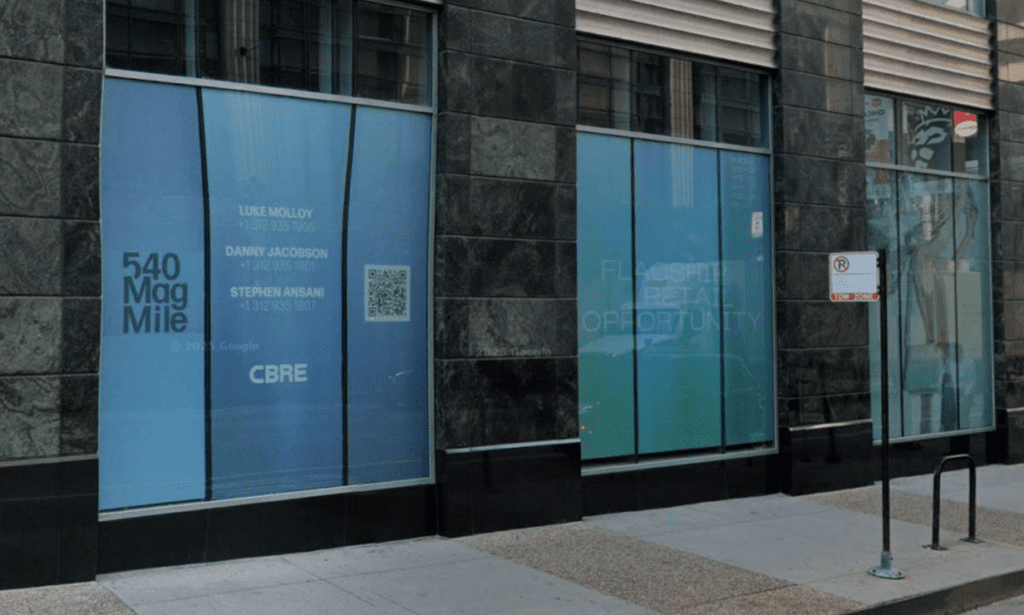
540 North Michigan was another dark stretch on the strip, more flagship retail opportunity sitting idle without a sail.
Heading south toward the Loop, the quiet vacancies gave way to flashing lights and movement.
The Loop sharpened the picture.
Outside Macy’s on Washington, Cook County Sheriff’s squads clustered at the curb.
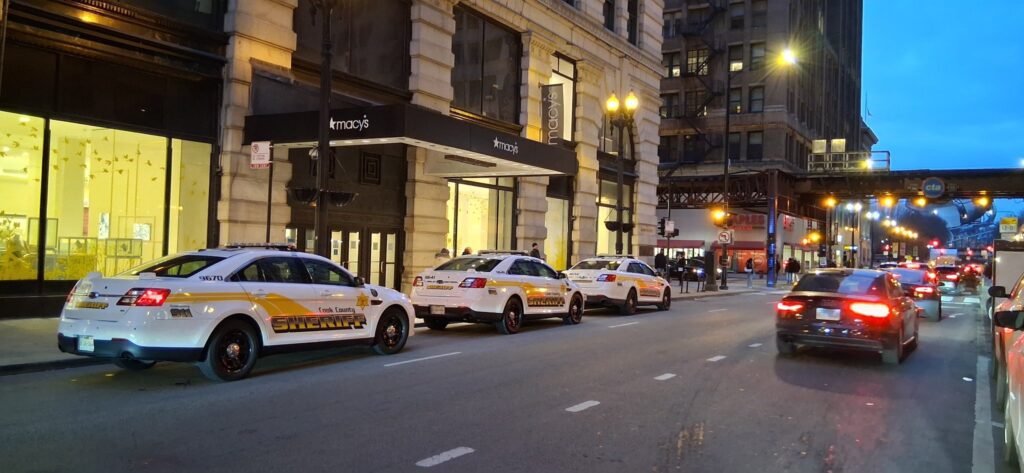
Deputies moved in and out through the revolving doors, apparently running a retail theft or enforcement operation inside a department store that used to be one of the city’s proudest.
A few yards away, Chicago Police officers drifted past looking at their phones.
For years, the city has known CPD is operating below its authorized strength.
Budgets fund more than 13,000 positions, but hiring and retention have lagged, leaving the department well short of that mark by its own measures. The gap has been papered over with overtime, shifting priorities, and outside help.
As of late 2025, CPD was running more than 1,000 officers short of its budgeted strength, with some estimates pushing that gap closer to 2,000.
At the same time, pursuit and paperwork rules have made it harder for officers to chase and grab thieves without risking discipline. The result was right there on State Street, the county stepping in to police downtown retail while city cops circled the edge.
A slow circuit through the central business district showed that the emptiness is not limited to one block.
On Jackson, LaSalle, and Wells, long stretches of storefronts sat shuttered, some papered over, others simply dark and waiting.
State and Ida B. Wells showed more dead frontage facing the street, exactly where the human cost comes into focus.
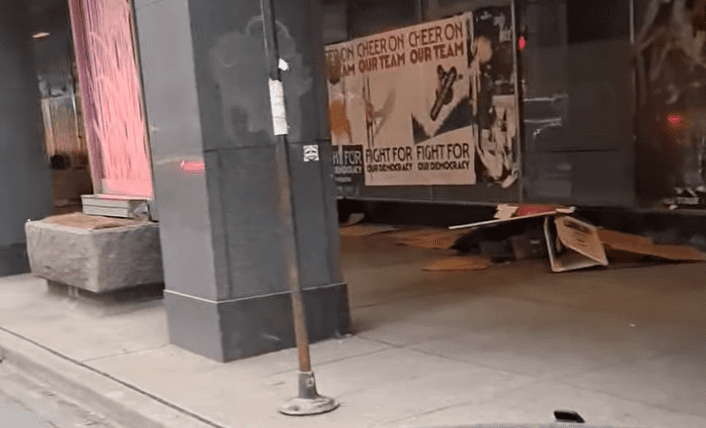
On the sidewalks and beneath the overhangs, people lay on flattened cardboard and thin blankets, coats pulled tight against the wind. You notice them first, the bodies on the pavement, the breath in the cold air. Then you look up and realize where they are.
They are lying outside an abandoned university.
The old Robert Morris campus, a full block of classrooms and offices at State and Congress, sat dark and locked above them. The merger with Roosevelt emptied it out.
Proposals circulate, housing conversions, vertical farms, mixed use ideas, but on this Friday none of that was visible.
What you had in front of you was simple, people sleeping on cardboard in the wind, and a dark campus over their heads that could house hundreds, maybe thousands, if anyone ever decided to unlock it.
City Hall talks about housing shortages and bold new plans. This corner showed something else entirely, a shortage of will to use what is already sitting in the middle of downtown.
Chaos in the lanes came next, as the streets themselves added a layer of disorder.
In the core, ride hail and delivery vehicles turned bus lanes and curb lanes into their own parking strips, backing up buses that had to swerve around them and forcing regular traffic into sudden lane changes.
Some drivers stopped in the middle of alley entrances and stayed there. Others cut across multiple lanes in improvised U turns, coming within a few feet of collisions.
Another radio story reported federal officials announcing that future commercial driver’s license tests for truckers and bus drivers will be administered only in English in the name of safety and clear communication.
Watching the improvisation on downtown streets, it was hard not to think the rules, whatever language they are written in, do not seem to count for much if no one on the ground enforces them.
Southside began bleeding before dark, when across town earlier in the same day, the scanner carried a call that began in confusion.
Around 5:15 in the afternoon, officers were dispatched to the area of 71st Street and Yates Boulevard for a report of a man shot.
When the first units arrived, they found no victim on the ground, no crowd around a body, and no activation from the city’s ShotSpotter system.
A job that came across the terminal under one classification was upgraded to a person shot code, but by then the only person who could explain what had happened was already gone.
Later it became clear that the victim, a 20 year old man known as BabyTop on the drill scene, had been loaded into a private vehicle and driven straight to the University of Chicago Hospital.
The missing victim was in critical condition with multiple gunshot wounds, the kind of case where seconds matter, and the decision to self transport may have bought him the time he needed.
For detectives, though, it meant trying to reconstruct a major shooting after everyone was gone.
Back at 7141 South Yates, officers found a white SUV believed to be tied to the crime. Left outside on the street curb was a child’s car seat, 5 pairs of shoes, and a flashlight for a handgun left scattered in the rush.
With no automatic gunfire alert, no victim to interview at the corner, and no clear witnesses lingering, the investigation had to start from that debris field.
Dusk at the Lakefront, Guns in the Water
Closer to downtown, as the light faded over Lake Michigan, another weapons call drew officers toward one of the city’s most photographed spots.
Just before 8:00 p.m., dispatchers reported 3 armed men under the Ohio Street Beach tunnel along North Lake Shore Drive.
Three male Black offenders in ski masks, guns visible, moving near 607 North Lake Shore Drive. Squads from the 18th District rolled north.
As they closed the distance, the group reportedly shifted north toward the 900 block and began hurling their firearms into the lake.
By the time it was over, 2 of the 3 men had been detained.
Gun calls kept coming.
Around 10:14 p.m., officers responded to 150 W Maple St on the Gold Coast for a domestic disturbance where a man was shot in the foot. The victim was treated on scene and taken to Northwestern Hospital in good condition. Area Three Detectives are now sorting out how a domestic argument in a high rise ended with a round fired.
Less than a mile away and about an hour later, the guns moved from the hallway to the camera. At about 11:18 p.m., police were dispatched to 540 N Michigan Ave after reports of a group with firearms filming on the roof at the Chicago Marriott.
They were shooting a music video on the Mag Mile. Officers ran a precautionary response, checking who was up there and what was real. On a Friday night downtown, guns on a hotel roof is not exactly the image this city claims it wants.
South Shore, Vacant Buildings, Lakefront Silence, and the Politics of Neglect
As the night pushed toward midnight, the drive along the South Shore lakefront told a quieter but heavier story than the police calls earlier in the evening.
Away from downtown lights, the streets near the water were still, the lake black beyond the shoreline, and block after block showed the same pattern, solid buildings with no life behind the windows.
Lakefront blocks showed the same reality again and again, structurally sound buildings sitting dark, unused, and waiting.
South Beach Apartments stood sealed and silent at 7827 South South Shore Drive, a large lakefront structure in a location that would be prime real estate in almost any other part of the city. Instead of lights, there was plywood. Instead of tenants, silence.
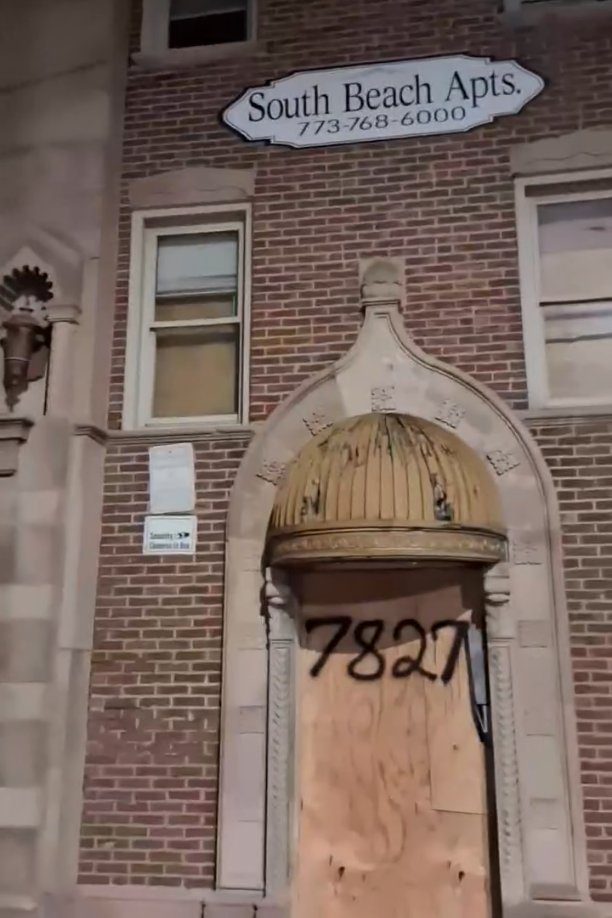
The building is a visual anchor for the broader question, whether Chicago’s housing problem is truly about space or about will to repair what already exists in Black neighborhoods.
A few blocks north near 78th and South Shore Drive, the scene repeated.
More multi‑unit brick buildings sit closed within walking distance of Rainbow Beach, prime real estate anywhere else in the country, left to rot under a Black mayor who promised the Southside would finally get its share and then never showed up here.
Properties that could hold families, generate taxes, and stabilize blocks remain unused, while public conversations somewhere else revolve around shortages and emergency solutions.
The drive ended at 75th and South Shore at 12:15 a.m.
Where is all that attention.
Where are all the cameras now.
Where is all the noise about housing and equity.
We ended up at the same building everybody was talking about when ICE showed up.
Tonight it is still sitting there boarded up, same plywood, same locked doors, same nothing.
All that outrage, all those statements, and nobody bothered to fix the place.
If folks in charge were really that concerned about people being put out, the simple move would have been to rehab it and put people back inside, migrants or locals, whoever needed a roof.
Instead it just stands there as another empty shell on a block that could use stability, a building with good bones left to sit while the big policy debates happen somewhere else.
Neighbors feel that in everyday ways.
Less activity. Fewer eyes on the street. Fewer customers for the spots that are still trying to hang on.
A building that once held people now holds nothing but questions.
On paper there are programs, funding streams, big ideas coming. On the sidewalk all you see is plywood.
City blames ICE.
Residents blame City Hall.
Bangers call it a trap house.
Cops confirmed a migrant murder inside.
Video shows it is closed.
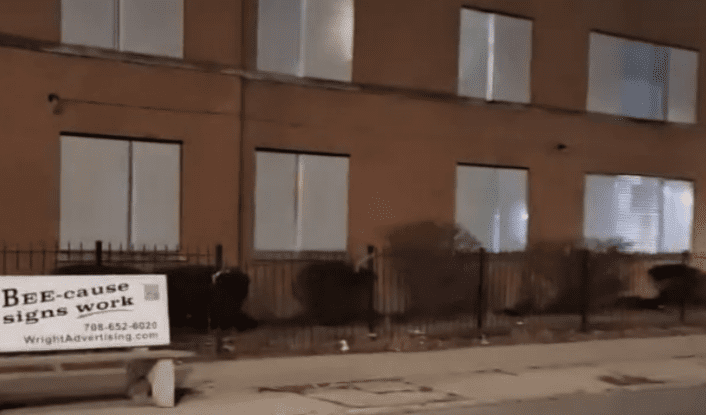
Standing there just after midnight, looking back on everywhere I had been that day, the pattern snapped into place.
Downtown vacancies.
Lakefront apartments sitting empty.
Boarded buildings on the South Side.
The issue is not simply market forces or population shifts. It is a pattern of uneven attention, investment flowing to neighborhoods that already attract capital while South Side corridors wait for repairs that never seem to arrive.
Reinvestment itself is not the problem.
Safer streets, functioning buildings, and new businesses are goals most residents share.
The tension lies in who benefits and who is left behind, long time residents facing rising costs while vacant structures nearby remain untouched, caught between speculation and neglect.
Rather than a pure shortage, what the South Shore blocks illustrated was an inventory problem, units that exist but are not maintained, buildings that could house people but remain offline, and policies that struggle to connect available space with those who need it.
The problem is not that Chicago does not have space.
The problem is how that space gets used, and who gets the attention when it is time to make decisions.
SubX.News® On the Spot Reporting
Image Garfield Green Line approximately 7:40 p.m. Feb 20, 2026 SubX.News®
