
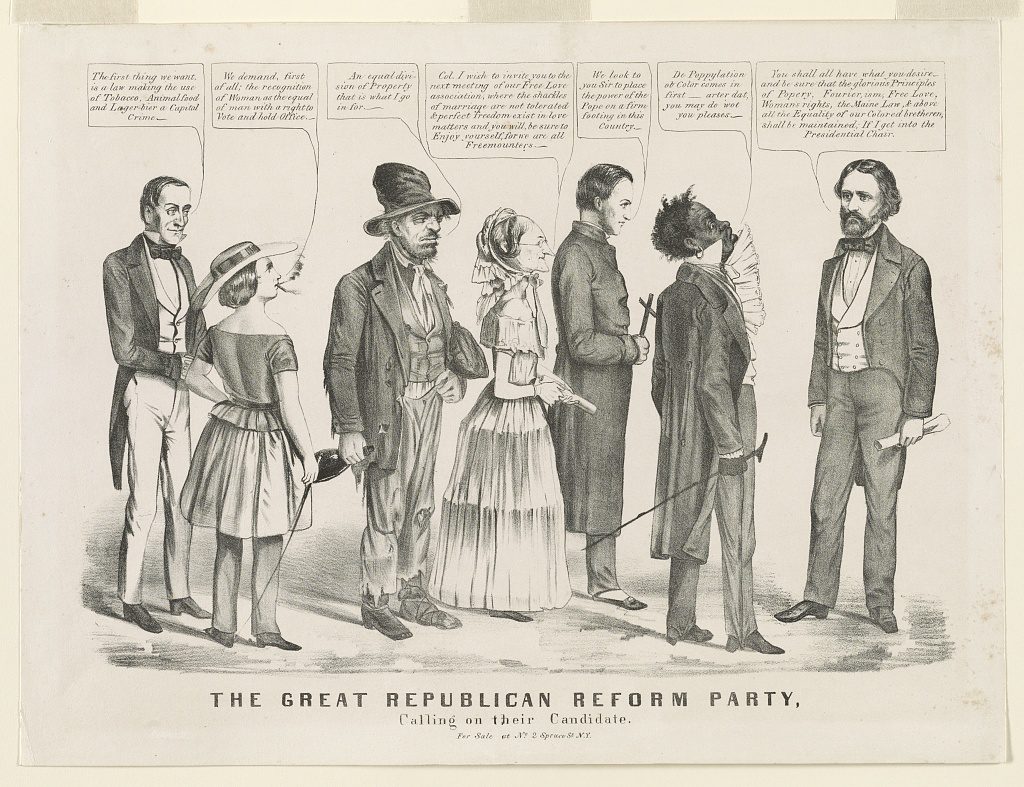
The Great Republican Reform Party (1856) Democrats sought to discredit the movement by portraying it as a chaotic coalition of extremists — a tactic as old as politics itself.
SubX.News® Historical Commentary | Oct 12, 2025
Cartoon targeted the newly formed Republican Party, which in 1856 represented a patchwork of anti-slavery reformers, abolitionists, temperance advocates, women’s-rights supporters, and others opposed to the expansion of slavery.
When The Great Republican Reform Party, Calling on Their Candidate was published in 1856, it wasn’t just a cartoon — it was a weapon.
Drawn by Louis Maurer for Currier & Ives, it ridiculed the fledgling Republican Party as a madhouse of radicals: the prohibitionist, the feminist, the socialist, the “free love” reformer, the clergyman, and the Black man — all demanding that their candidate, the explorer-turned-nominee John C. Frémont, promise them everything.
The Democratic message was simple: Republicans are extremists who will destroy America’s traditions.
That same playbook is still in motion today.
In 2025, establishment media, party operatives, and online influencers deploy the same cultural caricatures — only updated for the times.
Republicans are branded as “Christian nationalists,” “election deniers,” “anti-science extremists,” or “fascists,” while independent populists are cast as dangerous outsiders or threats to democracy.
And it cuts both ways: left-leaning coalitions face their own labels as “woke radicals” or “socialist hordes.”
The Faces Have Changed, But the Formula Hasn’t
Paint reformers as radicals.
Equate dissent with danger.
Mock coalitions as chaos.
In 1856, the targets were abolitionists and reformers demanding an end to slavery and corruption.
In 2025, the targets are citizens questioning censorship, border failure, or corporate control.
Back then, John C. Frémont was told he’d unleash moral anarchy if elected.
Today, any Republican or independent who questions the narrative is told they’ll unleash political collapse.
From Currier & Ives’ lithographs to TikTok clips and late-night talk shows, the medium evolved — but the method didn’t.
Political cartoons, memes, and media soundbites remain instruments of social policing, not just humor.
The lesson from 1856 still applies:
When the establishment feels threatened, it mocks reform as madness.
From Lithograph to Algorithm: The New Currier & Ives
In 1856, Currier & Ives mass-produced political satire on stone and paper.
Today, the same role is played by digital publishers, meme factories, and social-media algorithms.
Where Currier & Ives used lithographic stones, TikTok and X (Twitter) use engagement metrics — each designed to print ideology at scale.
Back then, a small New York print shop could sway public opinion with an image sold for ten cents.
Now, multinational platforms do it in milliseconds, for clicks instead of coins.
Currier & Ives portrayed reformers as radicals to keep power stable under the Democratic machine of their day.
Modern media often does the same — casting dissenters as extremists, populists, or threats to democracy, reinforcing the same social hierarchy with new tools.
Both industries sell the illusion of neutrality while profiting from polarization.
Both blur the line between journalism and propaganda — art and weapon.
The difference is scale:
Currier & Ives printed thousands of sheets; Big Tech prints billions of impressions.
What hasn’t changed is the method — mock, magnify, and manufacture fear to steer public sentiment.
🗨️ Dialogue Captions from the 1856 Cartoon
The Great Republican Reform Party, Calling on Their Candidate — Louis Maurer for Currier & Ives, New York, 1856
Left to Right – The Reformers:
Prohibitionist: “The first thing we want, is a law making the use of Tobacco, Animal food, and Lager-bier a Capital Crime.”
Woman’s Rights Advocate: “We demand, first of all; the recognition of Woman as the equal of man with a right to Vote and hold Office.”
Socialist: “An equal division of Property — that is what I go in for.”
Elderly Libertarian: “Col. I wish to invite you to the next meeting of our Free Love association, where the shackles of marriage are not tolerated & perfect freedom exist in love matters and you will be sure to Enjoy yourself, for we are all Freemounters.”
Priest: “We look to you Sir to place the power of the Pope on a firm footing in this Country.”
Freedman: “De Poppylation ob Color comes in first — arter dat, you may do wot you pleases.”
Frémont: “You shall all have what you desire — and be sure that the glorious Principles of Popery, Fourierism, Free Love, Woman’s Rights, the Maine Law, & above all the Equality of our Colored brethren, shall be maintained; If I get into the Presidential Chair.”
Next time you scroll a meme branding dissent as “fascism,” ask yourself:
Is this 1856 all over again?
Archival and Catalog Information
(Full bibliographic details preserved for transparency)
Title: The Great Republican Reform Party, Calling on Their Candidate
Publisher: [New York] : [Currier & Ives], For sale at No. 2 Spruce St. [1856]
Physical Description: 1 print : lithograph ; sheet 35 × 46 cm (13.25 × 17.75 in.)
Summary: Political lithograph mocking the coalition of reformers behind the early Republican Party.
References: Reilly, 1856-22; Weitenkampf, p. 117; Murrell, Graphic Humor, vol. 1, p. 185; Nevins & Weitenkampf, A Century of Political Cartoons, p. 76.
Printer: Currier & Ives, publisher.
Location: Library Company of Philadelphia | Print Department | Political Cartoons – 1856-22 [5760.F.100]
Accession Number: 5760.F.100
Reproduction Number: LC-DIG-pga-04866 (digital file from original item); LC-USZ62-10370 (b&w film copy neg.)
Rights Advisory: No known restrictions on publication.
Call Number: PGA – Currier & Ives – Great Republican… (B size) [P&P]
Repository: Library of Congress Prints and Photographs Division, Washington, D.C. 20540 USA
Digital Reference: https://www.loc.gov/pictures/item/2003656588/
SubX.News® on-the-spot reporting
