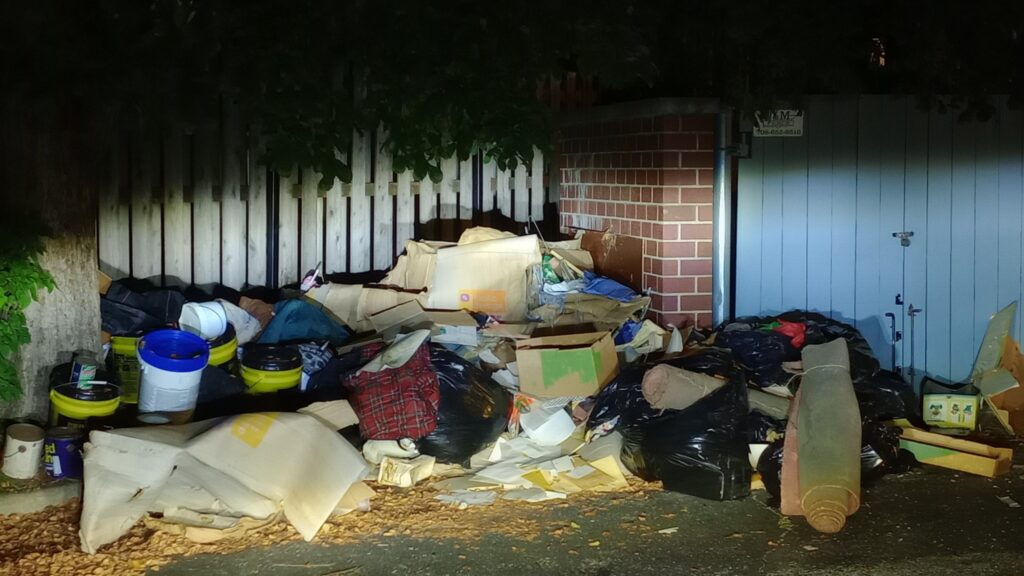
Fly dumped belongings of two women from Berwyn that have long since passed away at an abanadoned bank on the northside of Chicago Sept 24 2025.
The day moved like a siren. National shocks bled into local streets, then back again — a loop of institutions failing in different keys. By rush hour you could feel it in the way drivers inched past cruisers and in the way plywood swallowed corners that used to hum.
Morning broke with grim reports of a rooftop ambush at an ICE field office in Dallas.
A detainee was killed, two others critically wounded, and the gunman ended the assault by turning the weapon on himself.
The story hit Chicago airwaves just as commuters were pressing through clogged streets, a reminder that the politics of immigration and the violence that shadows it aren’t distant — they ripple into every debate about sanctuary, housing, and safety here.
That same newscast carried echoes of a mid-air tragedy in Washington, D.C., as families of victims sued American Airlines and the U.S. government over a helicopter collision that killed 67 people.
Closer to home, Midway Airport had its own surreal breach: a woman allegedly slipped into a hangar and drove a shuttle bus around the tarmac, shouting political slogans before being arrested. And a CPD officer was indicted for using his badge to funnel assault weapons south of the border, a scandal colliding head-on with a city still bleeding from nightly shootings.
The afternoon scanner painted its own canvas. At a Walgreens on Fullerton, offenders were described filling a suitcase with merchandise.
Not a petty grab — a full load-out in broad daylight, met with weary dispatch voices already knowing how it would end. That same store was hit again later that evening, a man in flip-flops reported stealing from the shelves — a repeat shopper in every sense.
Not a petty grab — a full load-out in broad daylight, met with weary dispatch voices already knowing how it would end.
Over on the West Side, Garfield Park filled with squads sweeping near Lake and Central Park, a heavy police presence that suggested something brewing but offered little clarity.
By evening, the borderlines of disorder stretched to Oak Park’s Harlem Green Line. Addicts and dealers clustered around porta-potties, bikes weaving through the mess, a man down needing an ambulance, fights breaking out with crutches for weapons.
CTA staff looked on like bystanders, enforcement muted, and the street kept moving around the chaos as if it were background noise.
Then came the north-side vigil at 2301 North Harlem. A bank still looking fresh — fenced, brick intact — yet dead on its feet, shuttered and abandoned.
Against its walls, a fly-dump pile told the other half of the story: carpeting, contractor bags, cartons, chemical jugs, Bibles, and ledgers.
Somebody’s house, somebody’s life, cleaned out and tossed into the open.
A rosary lay in the dirt, green beads catching the light, beside a shrouded bag that looked like it should have been buried, not left to rot.
Sifting through the debris revealed mail and ledgers stretching back decades, names of women from Berwyn who probably lived long, steady lives, their records now blowing in an alley.
It was a street-corner archive of 20th century Chicago — discarded at the same moment new red-light cameras, new taxes, and inflated housing costs choke the living. A symbol of how easily a lifetime is swept aside in an economy that feels like quicksand.
The day ended the same way it began: with institutions fading and the burden falling back onto the streets.
Shelters stretched, open-air markets reconfigured, the scanner reporting youth mobs at Addison and thefts in the Loop.
By night, the contradictions were plain.
And the bank pile said it all.
A century of letters, devotions, and family ledgers dumped against a fence — lives erased with the ease of hauling garbage. It was more than fly-dumping.
It was a mirror of City Hall’s playbook: take the past, the working-class foundations, the neighborhoods that built this place, and toss them aside in the rush for new development deals and borrowed billions.
The rosary in the dirt, the bank records blowing like trash, stand as symbols of an administration that talks equity while discarding memory.
Brandon Johnson’s government buries none of it with respect, just shovels it out of sight — the same way shuttered schools are boarded, migrants pushed from one plywood corner to the next, and Black and Latino neighborhoods drained by taxes while North Side banks cash in.
But in West Garfield Park, the Roses Still a Rose mural offered a counterpoint.
Under a viaduct where prostitutes have been killed and addicts left to rot, artist Blake Lenoir — known as B. Land — painted roses as reminders that the community’s people are still alive, still worthy of being seen.
“A lot of prostitution, a lot of killing, a lot of drug abuse,” he said, “but everyone is a rose.” His vision was the opposite of the abandoned bank pile — not erasure, but memory; not discarding, but honoring.
Lenoir’s work stood as proof that Chicago’s future depends on remembering its dead, not burying them in trash heaps. He can be found at V Land Artistry LLC on Instagram and http://vlandartistry.com.
Chicago is living a slow erasure.
What people built, what families carried for generations, what entire blocks once held together, is being written off as disposable.
The streets know it.
The alleys show it.
And the pulse of the city beats under the weight of that loss.
SubX.News® on-the-spot reporting
Source Note: This report is compiled from live SubXNews video feeds, on-the-ground reporting, police scanner traffic, and direct interviews conducted on September 24, 2025.