
SubX.News®Street Report March 9 2026
Monday afternoon started the way Chicago sometimes tricks you into thinking things are normal again.
The temperature pushed into the low seventies, the sky was clear, and for a few hours the city looked like it was finally shaking off winter.
Driving through downtown around four o’clock with the police scanner running and local news on the radio, the broadcast was filled with national headlines about the expanding war with Iran, rising oil prices, and airfares climbing as the conflict stretched into its second week.
On the street, though, the reality people were dealing with wasn’t overseas. It was block by block across Chicago.
Hubbard Street: A Security Guard Dies, the Party Stays On
One of the first stops was Hubbard Street, one of the city’s busiest nightlife strips and a major hub every year during St. Patrick’s Day week.
Earlier in the morning, inside Hubbard Inn, a security guard had tried to break up a fight. During the altercation another man allegedly pushed him down a flight of stairs.
The guard died from his injuries. By the afternoon, the bar appeared to still be operating.
The official Chicago Police summary describes it like this:
A 32‑year‑old male offender was involved in an altercation with a group of individuals at the above location, at which time the victim, a 35‑year‑old male, attempted to intervene.
The offender then pushed the victim, causing him to fall down the stairs. The victim sustained injuries and was transported to Northwestern Hospital, where he was pronounced.
The offender was placed into custody on scene. Charges are pending.
Filming the building, the question that kept coming up was the one Chicago residents ask all the time when violence hits certain neighborhoods but not others:
If something like this happened in many parts of the city, especially in Black or Mexican neighborhoods, the building would likely have a closure notice slapped on the door before sunrise.
On Hubbard Street, with St. Patrick’s crowds about to arrive, the doors were still open.
This is what failed leadership looks like: not just the homicide itself, but a city that applies one rule to River North and another to everyone else.
Downtown Looks Open but Feels Abandoned
From Hubbard, the drive and camera stayed in the downtown core.
The next thing that stood out was how quiet downtown looked on a day that should have been busy.
Wabash Avenue and the old Jeweler’s Row corridor, once packed with shoppers and office workers during the afternoon commute, now showed long stretches of empty storefronts.
“For Lease” signs hung in windows where businesses used to operate, and entire corners sat dark even though the sun was still high. Parking lots that once filled before rush hour sat half empty.
Crime, remote work, and declining retail have been hollowing out parts of the Loop for years, but seeing it on a seventy‑degree day made it harder to explain away.
If warmth and sunshine can’t bring people back, something deeper is wrong.
Downtown: Knife on the Sidewalk, Mental Health in Public
Still in the Loop, near the State Street college strip, the problems looked different but no less serious.
A man wandered along the sidewalk talking to walls and doorways, clearly out of touch while people walked past him.
As the camera rolled, a security guard suddenly bent down and picked up a knife from the pavement—apparently dropped by the same man moments earlier.
The guard and another worker started searching the area, trying to find him again, while students and commuters kept moving through the block like nothing had happened.
This is the version of downtown safety that never shows up in tourism ads: visible mental illness, a knife turning up on the ground, and a very thin line between “just another strange scene” and a serious attack.
The Loop has seen a rise in unprovoked physical assaults, including a high‑profile incident where a woman was punched near Daley Plaza in February.
These attacks are part of a broader trend of increasing violent crime downtown and on the CTA, leading to heightened security monitoring and public warnings for commuters.
In the same city where hundreds of officers can be mobilized for St. Patrick’s Day or a big parade, no one has figured out how to keep one unstable man with a knife from drifting through a college block in the middle of the day.
Transit Violence: 79th Street Red Line
While downtown prepared for another weekend of heavy drinking, the police scanner was already jumping with calls from across the city.
On the Red Line at 79th Street, officers were responding to a report of a man beating a woman on the platform.
The same station had already seen a shooting earlier in the week.
As units tried to locate the couple involved in the fight, another radio call reported that a K‑9 security officer had been punched in the face during the response.
These kinds of incidents have become routine across the transit system—fights, robberies, and assaults unfolding while trains continue to run and passengers try to keep their heads down.
The trains don’t stop, but neither does the violence.
Gunfire Across the Map
Elsewhere, gunfire continued to mark the day.
A teenager was shot during an altercation near Douglass Boulevard. Another man was wounded on the South Side after three offenders opened fire. Multiple victims were transported to hospitals across the city with gunshot wounds.
On paper, the weekend stats said there were 11 shooting incidents, 13 shooting victims, and 4 murders from Friday night to Sunday. By Monday, those numbers were already out of date.
One of the most serious incidents came just after midnight in Back of the Yards.
According to the official report, on the 5000 block of S. Justine:
The victims, a 19‑year‑old male and a 20‑year‑old male, were parked inside a vehicle when a dark‑colored sedan drove up.
Two male offenders exited and produced firearms, firing shots at the victims before fleeing. The 19‑year‑old sustained multiple gunshot wounds to the body and was pronounced on scene.
The 20‑year‑old sustained a gunshot wound to the back and was transported in critical condition, and was later pronounced.
Residents in the area have been talking for weeks about an ongoing gang war.
Double shootings and double homicides are no longer rare. They’re part of the cycle.
The Stolen Mercedes and the Shootout at Homan
By early evening, the situation escalated again.
The scanner lit up with reports of a stolen white Mercedes connected to shootings on the Eisenhower Expressway. Officers attempted to stop the car and the driver fled, leading police through West Side streets before crashing near North Homan.
According to police, the vehicle struck a CTA bus and rammed an unmarked squad car before officers fired their weapons.
The CPD preliminary statement puts it like this:
On Monday, March 9, 2026, at approximately 5:39 p.m., officers attempted to perform an investigatory stop on a vehicle in the 800 block of N. Homan that was wanted in connection to a possible shooting earlier in the day.
The offending vehicle fled, struck an adult female pedestrian, and came to a stop after striking a CTA bus in traffic and an unmarked squad car. As officers attempted to stop the vehicle and place the driver into custody, one officer discharged their service weapon, striking the offender.
A firearm was recovered.
The offender was transported to Mount Sinai Hospital, where he was pronounced.
When SubX.News arrived at the scene, the block was filled with police vehicles, investigators, and an ambulance.
The Mercedes sat damaged near the intersection while officers moved through the area collecting evidence. Local residents standing nearby described the neighborhood as part of a long‑running conflict between rival groups connected to Humboldt Park and Garfield Park.
Two years earlier, machine‑gun fire had ripped through storefronts nearby, hitting a Domino’s and a Wingstop during another flare‑up in the same drug corridor.
The shootout didn’t just shut down traffic. It shut down the neighborhood.
One of the small corner stores near the scene closed early because customers couldn’t reach it through the police tape and emergency vehicles.
CTA buses stopped running through the block. Inside the store, a young man who had come to get his phone fixed walked away empty‑handed.
Crime scenes don’t just affect the people directly involved. They choke off the few businesses still operating in neighborhoods already struggling to survive.
Leadership that only shows up after a shootout, with tape and helicopters, is leadership that’s already failed.
Debris, Neglect, and the Normalization of Damage
A little farther down the road, another reminder of the city’s decline sat along a boulevard where pieces of smashed car debris were still scattered across the pavement from an earlier crash.
No cleanup crew had arrived.
The wreckage had simply been left there.
It’s a small detail, but it fits into the same picture: violence, collisions, and damage that no one circles back to fix.
Under the Viaducts: Chicago’s Tent Cities
Later, the drive headed west toward the viaducts around Grand and Augusta, where another side of Chicago’s crisis has been growing quietly for years.
Under one bridge, a tent encampment stretched along the concrete wall, tarps and blankets tied to railings to keep the wind out. People were sleeping there, some with shopping carts or bags piled around them.
Many residents say drug addiction has become common in these camps, but the larger issue is that people simply have nowhere else to go. City crews clear encampments from time to time, yet the same tents often reappear a few blocks away within days.
Just before midnight, the drive reached another cluster of tents under the Sacramento viaduct.
Dozens of people were living there—some with dogs, others sitting outside small makeshift shelters.
One resident named Joe spoke openly about what life under the bridge is like.
The biggest problem, he said, isn’t that people don’t want help. It’s that the only “solution” the city offers most of the time is moving them somewhere else.
The conversation lasted only a few minutes around midnight before the drive moved on, but it captured a problem Chicago has been struggling to address for years.
Displacement is not the same as a plan.
Clearing tents without offering real housing or services is just another form of failed leadership.
And here’s the question a lot of folks watching are asking: How come migrants got housing—hotels, shelters, quick placements—right away when they arrived, while Americans born here end up under bridges and in alleys with no real plan?
It’s not about blame; it’s about fairness.
If the city can move mountains for new arrivals, why can’t it do the same for its own people who’ve been waiting years in the same system?
March in Chicago: Sunshine, Sirens, and “Madness”
By the time the night finally wound down just after midnight, the story of March 9 had unfolded the way many Chicago days do now.
The city began with sunshine and warm weather and ended with police shootouts, a downtown bar death, double homicides, tent cities under bridges, shuttered businesses, and another list of violent incidents scattered across the scanner.
The same city government that can’t keep teenagers out of stolen cars or people out of hallways with guns is also the government that can’t keep people from sleeping under viaducts in the middle of downtown.
It’s a pattern residents recognize immediately when temperatures start rising after winter.
Around here people call it spring.
Lately, it feels more like March Madness.
—-
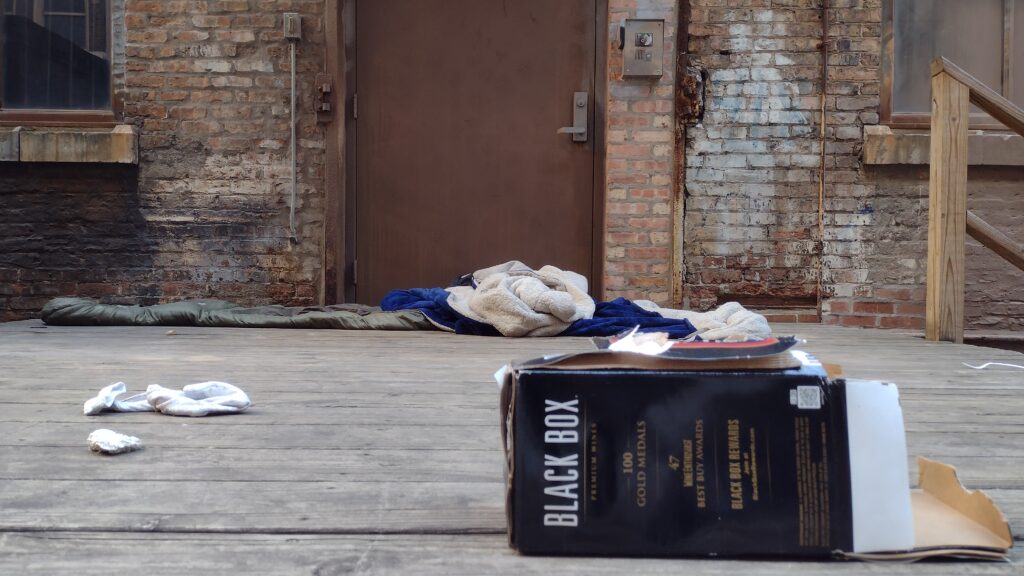
Image: Downtown Chicago alley behind the abandoned Robert Morris University campus, 4:57 PM · March 9, 2026 – SubX.News®
Editor’s Note: This report is based on a live drive on March 9, 2026, covering Lake Shore Drive, Streeterville, Hubbard Street, River North, Humboldt Park, live broadcast radio, police traffic, and independent scanner feeds:
Suspect Fatally Shot After Striking Pedestrian, Crashing Into CTA Bus, Firing at Police:
https://citizen.com/-OnJrmWwWh-PPF-p6tl6
Moving homeless people around – 12:24 AM, March 10, 2026:
SubX.News® On-the-Spot Reporting
What did you see? Drop your own sightings, photos, and street reports below.
Tag #SubXStreetReport so we can track what City Hall misses.
