
Chicago didn’t suddenly discover smoke on the ‘L’. It discovered it could no longer pretend it wasn’t there.
After years of rider complaints and visible disorder, the Chicago Transit Authority put the problem in writing. In a January 14, 2026 press release, CTA acknowledged that illegal behavior on its system has grown.
“Over the past few years, CTA has experienced a significant increase in the number of people smoking on vehicles.”
Smoking on CTA trains is illegal under Illinois law, Chicago ordinance, and CTA rules. When the agency admits the behavior has increased, it is admitting enforcement has failed on property the city directly controls.
The response was not enforcement.
At the CTA board’s first meeting of 2026, directors approved a 12-month pilot to install activated carbon air filters on eight railcars. As reported by Streetsblog Chicago, the goal was explicit.
“It’s not an effort to prevent smoking on trains, but rather an attempt to reduce the negative impacts of this behavior on respiratory health and rider experience.”
That distinction matters. The city is not trying to stop the crime. It is trying to make the aftermath less noticeable.
Longtime transit reporter Igor Studenkov placed the issue in historical context, noting that smoking was once more localized before spreading across the system.
“As someone who covered Chicago’s West Side for Austin Weekly News for much of the last decade, I can tell you that smoking on the ‘L’ has been a major issue on the Green Line for most of that era, especially later in the evening. What changed during the COVID-19 pandemic was that smoking on trains became more frequent and pervasive systemwide.”
Even CTA board members acknowledged the failure. Roberto Requejo described illegal smoking not as a temporary disruption, but as something the system has absorbed.
“We have now five to six years of experience of what it looks like when smoking becomes a feature of a transit system. Six years after the pandemic, and the issue still lingers.”
Calling a crime a “feature” is not reform language. It is surrender language.
CTA Acting President Nora Leerhsen offered no enforcement strategy. Instead, she said the agency is still looking for community organizations to conduct outreach to riders experiencing homelessness, addiction, or mental illness, and to help de-escalate situations. After more than a year, the program remains in the proposal phase.
“This would be a good time to put it all together,” Leerhsen said.
That admission underscores the larger problem. There is no operational plan to consistently enforce basic laws like the smoking ban. There is also no clear strategy to address serious criminal violence, even as overdoses, stabbings, and fatal shootings continue on CTA lines.
This comes despite a July 2025 executive order from Brandon Johnson promising to eliminate smoking on public transit using a “full-force-of-government” approach. Six months later, smoking has increased, enforcement remains inconsistent, and the city’s most concrete action is a contract to reduce odors after illegal behavior occurs.
The pattern is now impossible to hide. Laws exist. Authority exists. The city has chosen not to use them. Instead, it is spending public money to manage the consequences of disorder — a move that becomes common when failure can no longer be covered up.
CTA Innovation Studio is spraying Febreze on dope smoke and calling it progress.
References
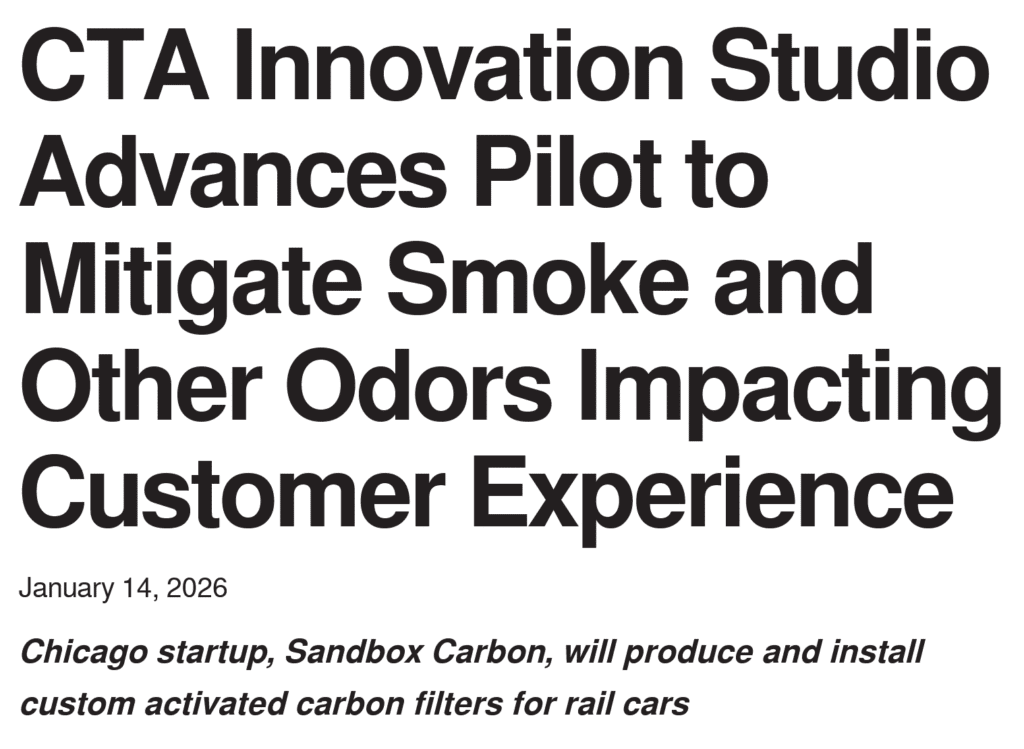
CTA Innovation Studio Advances Pilot to Mitigate Smoke and Other Odors Impacting Customer Experience (14 January 2026) Chicago Transit Authority
https://www.transitchicago.com/-cta-innovation-studio-advances-pilot-to-mitigate-smoke-and-other-odors-impacting-customer-experience-/
CTA board signs off on smoke mitigation pilot, discusses public safety challenges (15 January 2026) Streetsblog Chicago
https://chi.streetsblog.org/2026/01/15/cta-board-signs-off-on-smoke-mitigation-pilot-discusses-public-safety-challenges
CTA board approved a pilot to not prevent, but mitigate the negative impacts of smoking on the ‘L’ (15 January 2026) Streetsblog Chicago
https://x.com/streetsblogchi/status/2011820840606638379
CTA Have to Announce or Update Public Transportation Funding Safety plans By March 19th Deadline. It Needs a Full Approval by City council (15 January 2026) Adam Mack
https://x.com/AdamMack954213/status/2011825971150700623
Mayor Brandon Johnson Signs “Safe And Smoke-Free Public Transit” Executive Order (22 July 2025) City of Chicago Mayor’s Office
https://www.chicago.gov/city/en/depts/mayor/press_room/press_releases/2025/july/mayor-brandon-johnson-signs–safe-and-smoke-free-public-transit-.html
Smoke-Free Illinois Act (410 ILCS 82) (effective 1 January 2008; amended 2024) Illinois Compiled Statutes
https://www.ilga.gov/legislation/ilcs/ilcs3.asp?ActID=2893
CTA Rules of Conduct (current) Chicago Transit Authority
https://www.transitchicago.com/rules/
Chicago Municipal Code – Smoking Regulations on City Property (current) City of Chicago
https://codelibrary.amlegal.com/codes/chicago/latest/chicago_il/0-0-0-2639177
