
Strongest statistical warning: aggravated battery
Deadliest warning: combined movement in homicides, fatal shootings and multi-victim gunfire
SubX.News® Crime Report Aug 28 2026
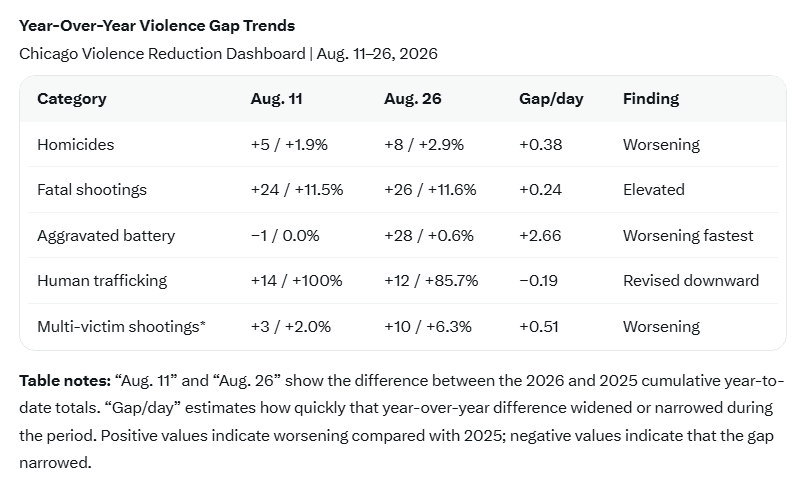
Year-Over-Year Violence Gap Trends
Chicago Violence Reduction Dashboard | Aug 11–26, 2026
These figures do not just ask whether crime totals went up in August.
They ask a simpler question:
Compared with the same dates last year, is 2026 getting better or worse, and how fast?
Each row shows how far 2026 was ahead of or behind 2025 on Aug. 11 and then on Aug. 26.
“Gap/day” is the estimated daily change in that difference. A positive number means the 2026 excess grew. A negative number means the gap narrowed.
In short, the table tracks whether Chicago’s comparison with last year is slipping, holding or improving.
What the Regression Shows
Aggravated battery deteriorated fastest. The category moved from one fewer victim than in 2025 to 28 more.
Its year-over-year gap expanded by an estimated 2.66 victims per day, with a strong R² of 0.82.
Homicides are trending upward relative to last year. The year-over-year excess widened from five to eight victims.
Regression estimates the gap expanded by 0.38 homicide victims per day. The percentage difference rose from +1.9% to +2.9%.
Fatal shootings remain persistently high.
The excess increased from 24 to 26 victims, but the percentage remained near 11% throughout the period.
Regression shows a modest widening of the raw gap, while the percentage trend is statistically flat. The problem is not a sudden spike—it is a sustained elevated level.
Multi-victim shootings show significant acceleration once the apparent Aug. 23 anomaly is isolated.
The adjusted regression indicates that the year-over-year gap expanded by approximately 0.51 incidents per day. The percentage difference increased by approximately 0.31 percentage points per day.
Human trafficking remains sharply above 2025, but the reported gap narrowed. The 2026 count was revised from 28 to 26 while the 2025 comparison remained at 14.
The year-over-year increase narrowed from 100% to 85.7%. The change may reflect case reclassification rather than an actual decline.
Bottom Line
Three categories show clear deterioration relative to 2025:
- Aggravated battery
- Multi-victim shooting incidents
- Homicide victimizations
Fatal shootings remain approximately 12% above last year, but the short-term percentage trend is essentially level.
Human trafficking remains dramatically elevated, although its reported count was revised downward.
The strongest statistical warning is aggravated battery.
The deadliest warning is the combined movement in homicides, fatal shootings and multi-victim gunfire:
- More killings
- Sustained fatal-shooting excess
- Widening concentration of shootings involving multiple victims
Table notes: “Aug. 11” and “Aug. 26” show the difference between the 2026 and 2025 cumulative year-to-date totals. “Gap/day” estimates how quickly that year-over-year difference widened or narrowed during the period.
Positive values indicate worsening compared with 2025. Negative values indicate that the gap narrowed.
R²: Homicides 0.46 | Fatal shootings 0.30 | Aggravated battery 0.82 | Human trafficking 0.72 | Multi-victim shootings 0.68
*The multi-victim regression excludes the apparent Aug. 23 dashboard anomaly, when the 2026 count fell from 164 to 140 before rising to 167 the following day. Including that unexplained revision erases the measurable trend.
Violence and Victimization Trends
https://chicago.gov/city/en/sites/vrd/home.html
