
SubX.News® Street Report April 1, 2026
On a spring afternoon, an 18‑year‑old on the Southside is executed, an eight‑year‑old is shot outside a strip mall.
Same city. Same day.
By nightfall the carnage is spinning through social media like serialized entertainment.
In Chicago’s new economy of violence, children, teenagers, and bystanders are no longer at the edges of gang warfare—they are the battlefield.
On April 1, Chicago’s official story began, as it often does, at a podium.
On the street, the day looked very different.
As officials sold a future of reallocated officers from beats to offices and expensive “affordable” units next to train stations, Chicago’s core was already showing what those blueprints leave out.
The State Street bridge, newly reopened after months of closures, carried traffic again, but its surface told another story: potholes, broken seams, a deck that still buckled under tires.
A few blocks away, near Ida B. Wells and State, people lay on cardboard on the sidewalk, half‑covered by blankets and coats, within sight of glass towers and marketing banners that promised a safer, more “affordable” downtown.
This was the city’s front porch—patched just enough to reopen, never fully repaired.
The language from the podium was clinical and optimistic: blueprints, restructuring, opportunity.
If you stayed with the press release, you’d think the crisis was mainly one of spreadsheets—where to place bodies, how to stack subsidies, which neighborhoods to color in on a map.
A few miles away, a different record of the day was already in progress.
On the scanner and through a windshield, the city did not look like a series of programs; it looked like a series of crime scenes waiting to be confirmed.
In the late‑afternoon window when school lets out and commuters begin to crowd the buses, gunfire tore through a strip mall at 35th and Rhodes.
At 4:45 p.m., the dispatcher’s voice cut through:
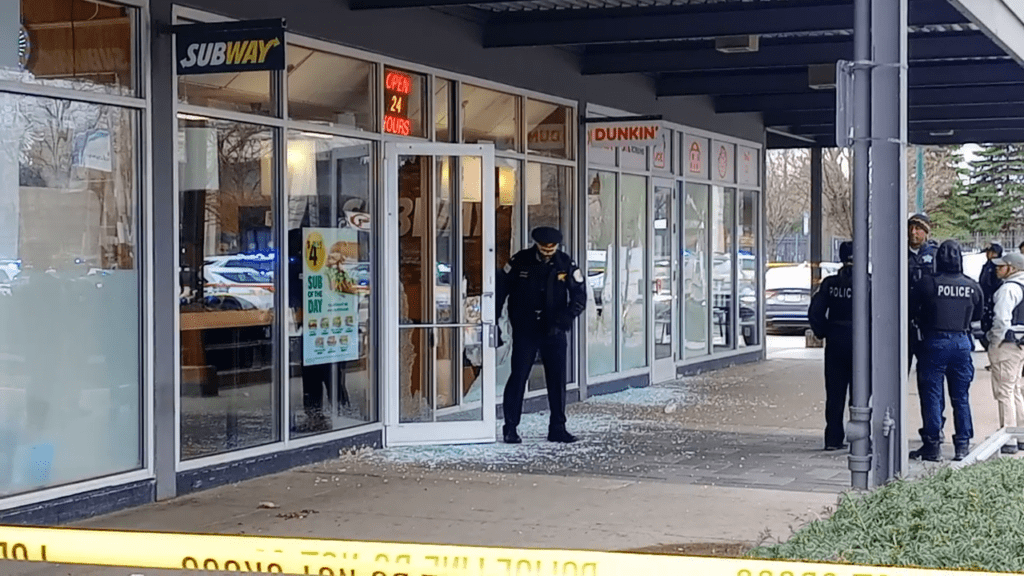
Three shot … 35th and King Drive, outside the Dunkin’ and Subway.
The façade that is supposed to signal stability—a fully occupied strip mall, a school across the street, and a parking lot where parents idle with coffee while kids drift in and out with snacks—looked as if it had been put through a blender.
Glass was spider‑webbed, storefront windows blown out, shell casings scattered across the pavement.
Three people were hit: a local rapper who performs as Camo Bucks, an eight‑year‑old child, and another person.
Street and social media chatter claimed all three were related, with the rapper as the intended target.
The evening rush evaporated.
The businesses went dark behind yellow tape. A normal weekday was erased in a few seconds of gunfire.
South of there, at a gas station at 67th and Wentworth, the day’s violence took on a different shape.
If the strip mall showed the collateral damage of neighborhood feuds, this scene read as a calculated message.
The station was ringed with squad cars and evidence markers; detectives walked a grid of shattered glass and twisted metal.
That’s a murder right there… there’s a machine‑gun killing here. Look at that—at least forty‑seven bullet casings.
An 18‑year‑old, known on the street as Big Black, had been cut down in what resembled an execution more than a robbery.
Multiple shooters. Tight groupings.
Doors and windows stitched with rounds, as if the goal was to erase not just a person but a presence.
By the time the body was removed, the geometry of the bullets remained, etched into the building.
All three strip mall victims survived.
The 67th and Wentworth attack was fatal.
From those two scenes alone, it would be possible to write a day in the life of Chicago’s feuds: a strip mall where an eight‑year‑old and a rapper bleed on the sidewalk, a gas station turned into a private firing range for a set dispute.
The map did not light up only on the South Side. As the clock pushed toward night, calls came in from every corner of the city.
On the Far Northside, officers were dispatched to 5200 North Cumberland for a road‑rage incident: a black Infiniti whose driver allegedly pointed a gun at another motorist around 8:55 p.m.
A little later in Wicker Park, a 10‑1 went out—an emergency call for help—after a driver allegedly rammed an off‑duty officer’s vehicle at Damen and Le Moyne just before 9:45 p.m.
The neighborhoods that real‑estate brochures advertise as “up‑and‑coming” and “walkable” were, in practice, one bad decision away from the same kind of chaos.
The Southside and Westside continued to generate their own stream of emergencies.
Over on 79th Street near Baba’s, a man with a knife was reported going in and out of the restaurant, threatening staff around 10:24 p.m.
At 2344 West Chicago, someone tried to run another person over in a Burger King drive‑through just after 11:11 p.m.
Not long after, at a gas station on North Avenue, a caller reported a stabbing at 3142 North—another late‑night crime scene on the West Side just after midnight.
Even as the calendar flipped to April 2, the center of the city looked little safer than the edges.
Around 12:39 a.m., at Chicago and State, an ambulance without visible markings pulled up to the Red Line entrance to load another man out of the station, most likely for an overdose.
The platform that features in tourism brochures and transit ads was, in the overnight reality of the scanner, just one more place where someone could collapse unseen until help arrived.
Strung together, these calls showed a city with no real safe zone.
Northside residential corridors, Southside strip malls, Westside gas stations, and the downtown rail spine all produced the same pattern:
guns, blades, cars used as weapons, bodies pulled out of public spaces by overworked medics and officers who often arrive only after the damage is done.
The overdoses showed how thin Chicago’s own presence has become.
Sheriffs handled the narcotics bust at 95th; an unmarked ambulance scraped an overdosed rider off the platform at Chicago and State.
In a city that promises “treatment not trauma,” the basic work of prevention—keeping guns and fentanyl off trains in the first place—was quietly handed off to everyone but CPD.
The result was a city where nobody could count on being upstream of the damage.
Anyone just trying to get home wasn’t skirting the edge of gang conflict anymore.
They were standing in the middle of it.
People are not platitudes on paper or lines at a podium.
They spill real blood.
Image – Three people were shot outside a Dunkin’ Donuts and Subway in the Lake Meadows Shopping Center at East 35th Street and South King Drive around 4:45 p.m. April 1, 2026
This report is based on real‑time Chicago police radio traffic and more than eight hours of on‑scene video, radio calls and eye witness documentation recorded on April 1–2, 2026.
Chicago economy crime and migrant update 400pm April 1st 2026 https://youtu.be/snYA35fnm6U
State Street bridge is finally 421pm April 1st 2026 https://youtube.com/shorts/FOrpd78KVRY
More trauma people sleeping on the sidewalk 450pm April 1st 2026 https://youtube.com/shorts/EAnefDDBbJE
8 year old girl shot in triple shooting 35th and Rhodes 445pm April 1st 2026 https://youtu.be/LV4fhUCcb-I
18 year old shot and killed by four offenders 67th and Wentworth 418pm April 1st 2026 https://youtu.be/smFeNZ3gv8I
Narcotics bust Cook County Sheriff’s needs a dog 95th Red Line 709pm April 1st 2026 https://youtube.com/shorts/x_3ox1dciqM
Car flipped over on his roof 95th and Bennett 755 pm April 1st 2026 https://youtu.be/x-aYLREPXhk
Felony vehicle stop by the Riverdale at 95th and Avalon 940pm April 1st 2026 https://youtu.be/c-kia7w49VE
EMS Presence Near Chicago and State Red Line Station Overdose 1239pm April 2, 2026 https://youtu.be/H0c6xPIw0jc
