
SubX.News® Street Report – June 8, 2026
Monday evening rush on Chicago’s lakefront ended in twisted metal and flashing lights a multi-car pileup on the Lake Shore Drive S-curve that residents say never had to happen.
Scanner traffic earlier in the hour carried a simple warning: debris in the roadway. No street crew arrived, no emergency cleanup followed.
Minutes later, multiple vehicles were wrecked, traffic was stacked northbound, and yet another preventable crash became part of the city’s background noise.
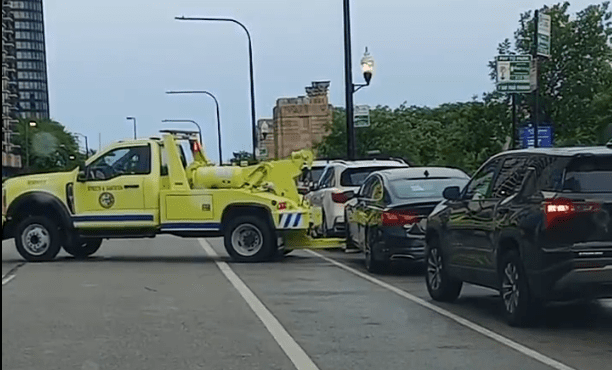
While that debris sat unaddressed, a city tow truck was working a very different corner of downtown. Near Millennium Park, the operator quietly hooked up a legally parked but overtime vehicle in a paid space no ticket on the windshield, no emergency, just a clean predatory tow.
As police radio confirmed a three-car accident on Lake Shore Drive, the truck rolled off with a tourist’s car instead of heading toward the S-curve to help clear a known hazard.
This is how priorities look on the street in 2026 Chicago: debris is allowed to sit on a major artery until it produces a crash; a city contractor chooses revenue over safety; and residents lose time, money, and sometimes lives while officials sell a “summer safety plan” from the podium.
Earlier in the broadcast, city leaders promoted that plan as a success. Public health officials praised last year’s “summer injury prevention” strategy, claiming a 34 percent reduction in gun violence and a 12 percent drop in overdose calls tied to mental-health teams, safe-space coordinators, and door-to-door Narcan distribution.
At the same time, weekend numbers from this year painted a different picture: homicides up roughly one-third, shootings doubled, and at least one mass shooting that left four children wounded in Bronzeville, all between the ages of 12 and 14.
Separate triple shooting in Englewood barely registered in mainstream coverage.
On the streets, the disconnect was obvious.
Near State and Lake, three Chicago police officers walked out of a downtown station while a man openly drank alcohol at a CTA stop just yards away.
Nearby, a disabled man with both legs amputated suffered what appeared to be a drug-fueled episode at the Lake and Garvey encampment, shouting and throwing objects as foot traffic moved past.
City worker in a municipal truck pulled up, interacted briefly, and left the scene essentially unchanged. No ambulance. No crisis team. No meaningful intervention.
Around the same corner, a familiar pattern repeated: visible drug markets anchored to transit infrastructure, with users and dealers mingling under shelter from the rain.
Bus stops were occupied end-to-end by people sleeping or using, leaving regular riders with nowhere to sit and no safe space to wait.
Plywood covered windows nearby told their own story: repeated break-ins, assaults, and property damage normalized into the urban landscape.
While this played out downtown, scanner traffic chronicled a second front:
White Nissan Maxima, reported stolen, had been seen the previous day in the 22nd District with occupants firing handguns out the windows near 93rd.
On this day, that same car reappeared on the Dan Ryan, the chase bouncing through locations – 87th and Holland, 83rd and Holland, 81st and Harvard, 81st and Stewart – before officers finally took suspects into custody.
One gun with an extended magazine was recovered; at least one offender initially fled on foot through alleys and side streets.
Other calls stacked up around the city: a woman allegedly beating someone with a Stanley Cup on South Muskegon, a fight in progress in an apartment near 63rd, a domestic battery in Arlington Heights where an 18-year-old woman reported being choked by a man on a bike, and a string of disturbances and batteries on CTA platforms.
Each incident, on its own, might be written off as another bad night in a big city.
Taken together with the street-level footage, they form a continuous thread: a city where enforcement is selective, resources are misallocated, and the daily risks fall hardest on ordinary residents trying to get home from work, ride a train, or walk through the Loop.
Even the press system that traditionally exposes those contradictions is under pressure.
Chicago Police Department revoked long-held media credentials from a SubXNews reporter after an arrest involving a sergeant – before any court resolution.
The move stripped access to internal police bulletins and certain official areas but did not stop the reporting.
It simply made it easier for City Hall to distance itself from uncomfortable questions about crime numbers, enforcement patterns, and public safety failures.
Downtown, the evidence of those failures was impossible to miss:
Empty streets and surface lots at 5:00 p.m. on a muggy Monday, where rush hour once packed the Loop with cars, taxis, and commuters.
Sparse traffic at major CTA stations, even as officials insist that Chicago is “back.”
Repeated sightings of encampments, open drug use, and people passed out or in crisis at key intersections and transit nodes.
Plywood and boarded windows in what should be prime commercial territory, standing as quiet indictments of both crime and neglect.
On the airwaves, advocates for safer streets and better bike infrastructure sharpened their tone after the death of Riley O’Neill, a 35-year-old CDOT employee and bike-safety worker killed Friday in Bridgeport. O’Neill reportedly tried to maneuver around a car parked in a marked bike lane on Halsted, lost control, and fell into the path of a semi truck.
Bike organizers were blunt:
“Riley would be alive today if there were protected bike lanes on Halsted. That’s just a matter of fact,” said one advocate.
“If our elected officials continue to drag their feet on this, we’ll find new ones,” said another.
The message was clear: City Hall can no longer trade on “equity” rhetoric and half-built bike lanes while cyclists, pedestrians, and neighborhood residents pay the price.
By the end of the evening, as traffic inched past the wrecks on Lake Shore Drive and tow trucks finally arrived where they were truly needed, the day’s pattern had set hard:
Warnings ignored until damage is done.
Addiction and homelessness managed as optics problems rather than human crises.
Gun crime acknowledged in press conferences but left to spin on the scanner.
Revenue-generating enforcement – tickets, tows, fines – deployed aggressively, while life-and-death hazards sit untouched.
Officials insist Chicago has a plan.
The scanner, the street, and the S-curve tell a different story.
Image Upper Randolph Street near Millennium Park, 6:22 p.m., June 8, 2026. A city-contracted tow truck removes a vehicle from a paid parking space while emergency calls elsewhere reported roadway hazards and crashes during the evening rush hour SubXNews®
Editor’s Note: This report is based on a live video drive, broadcast radio traffic, and independent police scanner feeds.
Drugs, Crashes and Predators … Chicago economy crime and migrant update 4pm June 8th 2026 https://youtu.be/OmD_h8FB_J0
rain just started coming down Wild 455PM June 8th 2026 https://youtube.com/shorts/V8fpUj_I_Bc
Picture tells the story there’s no one here in downtown 510pm June 8th 2026 https://youtube.com/shorts/4wHglkLY1uQ
Chaos at the drug spot even in front of the city worker Lake and Garvey 530pm June 8 2026 https://youtube.com/shorts/dIhGPz4n3yg
Predatory towing this guy illegally towed a parked 622pm June 8th 2026 https://youtube.com/shorts/s76tSe8R1P4
Preventable accident on lakeshore drive northbound at the s curve 645pm June 8 2026 https://youtube.com/shorts/11HSxO2nFB4
No Place to Sit in the Rain … Chicago is the criminal selfish city 702pm June 8 2026 https://youtube.com/shorts/oIb7g5fcAKc
previous accident with no city tow trucks Four car accident southbound Lakeshore Drive at 1240 North Lake shore Drive 556pm https://youtube.com/shorts/vt6HUkQupq4
SubX.News® On-the-Spot Reporting
