
SubX.News® Street Report – April 30, 2026
Chicago closed out April the same way it’s been running all month—movement on the radios, standstill on the streets, and a system that looks intact on paper but keeps breaking in real time.
By late afternoon, the Loop was already thinning out. Traffic reports stacked into gridlock—Eisenhower over an hour, Tri-State backed into construction—but downtown itself wasn’t moving like a city at rush hour.
Open lanes. Light foot traffic.
Long stretches where density used to carry the block.
The infrastructure is still there. The people aren’t.
Inside the news cycle, the top story stayed fixed on the Swedish Hospital shooting.
The man accused of killing Officer John Bartholomew remained in custody after a detention hearing, with prosecutors outlining a sequence that started with a robbery, moved through an arrest, and ended with a gun somehow making it into a hospital room.
Seven prior felonies. Electronic monitoring. A courtroom where, according to reporting, the suspect smiled and laughed as his record was read out loud.
At the same time, city leadership stood over a red steel beam in River West, marking the next phase of the Bally’s casino buildout—$1.7 billion, 500 hotel rooms, a theater, jobs promised, signatures written across a structure rising while other parts of the city sit hollow.
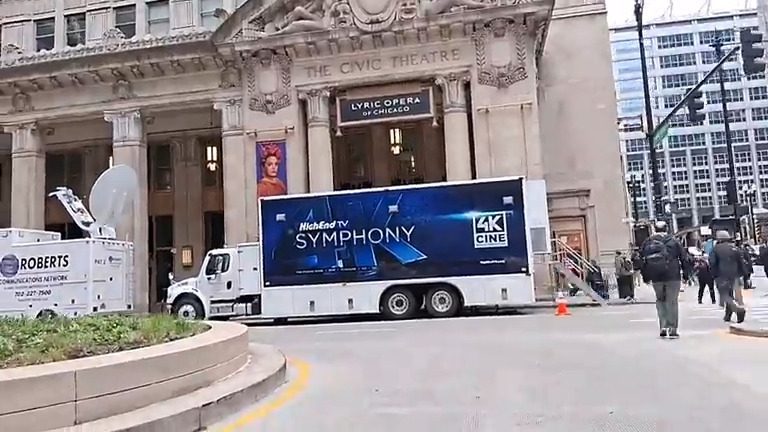
At the Civic Theatre, the Lyric Opera of Chicago was live to the world—broadcast trucks lined the curb, a full production setup pushing International Jazz Day out in 4K to a global audience.
Inside, it was a “love letter to Chicago,” packed with talent, political appearances, and international attention, led by Herbie Hancock, who once attended Hyde Park Academy High School.
Just weeks earlier, another story tied to that same school played out on the street—a Hyde Park Academy student shot and killed another student at a CTA bus stop near 63rd and Stony Island.
Two versions of the same city, running at the same time.
Step outside, and it didn’t carry.
No crowd spillover. No packed sidewalks.
Just a controlled perimeter, a few people moving through, and traffic sliding past like nothing was happening.
The city can still stage the moment.
It just doesn’t fill the street around it anymore.
On the scanners, the real-time city told a different story.
A carjacking crew moved through the South and West Side corridors, reportedly impersonating police—vests, coordinated approach, multiple vehicles.
One call tracked a silver Mitsubishi Outlander running westbound on I-55. Another vehicle tied to the same crew, a rental Toyota RAV4, was picked up entering I-94 near Chicago Avenue.
Rush hour timing.
Highway access.
Organized movement.
Elsewhere, a man flagged for aggravated battery—previously holding a knife to a victim’s neck—was reported moving toward the CTA Green Line, possibly armed again.
Calls stacked behind it: a battery in progress at 73rd and Stony Island, a disturbance inside a South Side liquor store with a man foaming at the mouth, a gun call near West Illinois, smoke reported on Lake Shore Drive, and another individual dropping a weapon near 61st and Vernon.
It never spreads evenly. It pulses.
Chicago’s official crime numbers still move in waves—early drops, then steady climbs that bring totals back in line or above prior years.
Week-to-week swings look dramatic when counts are low, but by the end of the month, the pattern settles into something more familiar.
What shows up in the data doesn’t always match what shows up on the street.
The numbers lag. The calls don’t.
By April 30, whatever early dip showed up in the stats had already been replaced by what people were seeing in real time—carjackings, armed offenders on transit, and a steady run of violence that doesn’t wait for a weekly report.
Federal cases layered in from outside the city: a Chicago man pleading guilty to laundering $3 million tied to Mexican cartels, routed through China.
In Northwest Indiana, nearly two dozen people named in a gambling and extortion indictment tied to restaurant fronts and local operations.
At the policy level, another investigation opened—this one into more than 30 Illinois school districts over curriculum content and whether parents were properly notified of their right to opt out.
City officials were caught with their hands in the cookie jar on Archer Avenue, walking back parts of the “Complete Streets” project in Brighton Park after weeks of backlash from residents and small business owners.
Millions spent—and now parts of it are coming back out.
CDOT is removing sections of newly installed concrete bike lanes near Albany, reconfiguring intersections like Christiana, and restoring at least 17 parking spaces after the damage was already felt on the street.
And over all of it, the same pattern: systems reacting after the fact.
Gas settlements issued after years of overcharges.
Flood resource centers opening after damage is already done.
Court hearings explaining how someone already under supervision moved freely enough to escalate into something fatal.
Out on the streets, none of that plays in real time.
What shows up is the delay on the expressway. The empty block where business used to be. The call that comes across the radio just a little too late.
By the time the sun dropped on April 30, the city hadn’t slowed down—it had just spread out. Less visible in some places, more concentrated in others. Less crowded, but not quieter.
The movement is still there.
It’s just not where it used to be.
The fat lady’s singing.
