
SubX.News® Street Report March 25, 2026
Chicago operated on two very different systems on March 25, 2026.
In the polished version, the day brought routine headlines: the Dow rose more than 300 points, a new airline seat class promised bigger screens and mattress pads, and shutdown talks threatened longer TSA lines and delayed flights.
In the raw reality—driving from Lincoln Park to South Kedzie, lakefront beaches, migrant shelters, college campuses, and finally the Loop—public spaces told a different story:
- Americans sleeping in tents outside shelters housing migrants,
- Older man shot near an abandoned CHA building,
- 18 year old Loyola freshman murdered on the lakefront,
- 21 year old student raped on a public campus,
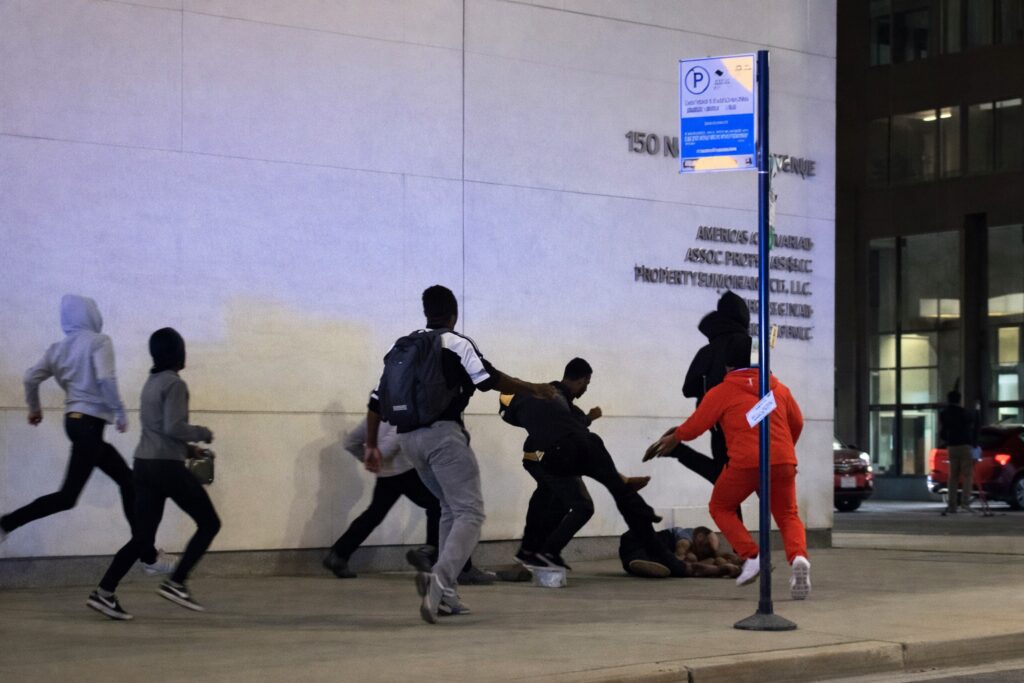
- Hundreds of teens rioting through State Street and Michigan Avenue before being swept out at curfew.
The question that ran through every scene was:
Who are they protecting? The answer that emerged was blunt:
The criminals, and the system that enables them.
Two Worlds, One Neighborhood: Migrants Sheltered, Americans in Tents
The clearest snapshot of Chicago’s double standard came at a repurposed Islamic college serving as a migrant shelter.
Baby carriages and cots—some still bearing airline tags—were being cleared out as operations wound down. Out‑of‑state plates from Minnesota and Wisconsin filled the parking lot.
Just a few blocks away, along Marine Drive and Montrose, rows of tents housed Americans sleeping outdoors.
Inside the shelter, migrants received food, lodging, health care, and other services. Outside, American citizens slept in tents on the same streets, in the same weather, under the same skyline.
Reports from the area described drug dealing, prostitution, and the smell of marijuana near a nearby Disney magnet school at dismissal time, as kids walked past a corridor of tents and lingering smoke.
The contrast was brutal and simple: full services for one group inside the building; tarp roofs and sidewalk mattresses for another group outside.
It showed exactly where the city and its partners were choosing to aim resources—and where they were not.
Anarcho‑Tyranny at the Lakefront: Gates for Drivers, Tents for the Homeless
The same pattern played out at the lakefront, where new steel gates and paid parking machines had appeared “overnight” at Montrose and Foster Beaches.
Signs now read: No trespassing. No loitering. Pay here—or risk ticketing and towing.
This was anarcho‑tyranny in concrete form: strict enforcement against working drivers who have licenses, jobs, and plates, while tents housing the homeless stood just yards away, largely untouched.
Enforcement went after the people with cars because they have licenses and can pay fines—not the people living in tents with nothing to take.
Public land owned by the Chicago Park District—beaches long intended under the Burnham Plan to remain “forever open, clear and free”—now featured what looked like anti‑worker gates.
Fresh concrete bases supported new pay kiosks, installed quickly and looking like shoddy work done in a thief‑in‑the‑night manner.
Money that could have gone into housing or services was poured into hardware to charge people for parking on land their taxes already paid for, while tents multiplied in the same parks.
Denying Access to the Disabled
The lakefront changes hit disabled residents especially hard.
Handicap‑accessible spaces closest to the beach—once a practical ADA access point—were converted to paid parking with no equivalent free alternative nearby.
Now, handicapped individuals have to pay for the same access they previously had, or park farther away and struggle across distance and bad pavement.
These changes effectively stripped away a working ADA accommodation and turned it into a revenue stream. In practice, they looked less like “equity” and more like taxation of disability, imposed quietly, kiosk by kiosk.
While the city’s official language celebrates inclusion and access, the actual situation at Foster Beach showed wheelchair users treated as just another source of parking revenue—even as tents and encampments remained untouched a few yards away.
The Shooting on Kedzie
Later in the afternoon, the focus shifted southwest to South Kedzie.
Just before 6 p.m., gunfire erupted in the 1300 block of South Kedzie, behind the abandoned Chicago Housing Authority building at 1325 S. Kedzie.
A 65‑year‑old man sitting near cars and coolers in an alley was shot as someone fired roughly nine rounds from, or around, the derelict structure.
He was simply sitting there, not doing anything wrong, when the area was lit up with gunfire.
It was intentional there was a round near where his body fell showing that teh shooter wanted to make sure he was hit.
The incident fit a larger pattern of South and Westside shootings that day.
What stood out was the police response at the scene: officers appeared more focused on stopping the recording of a public crime scene than on the shooter who had just targeted a civilian.
When told to stop filming, the reporter pushed back, asking why an abandoned CHA building had been allowed to remain a sniper’s nest in the first place.
The exchange highlighted the central question behind the whole day: priority seemed to be placed on the camera rather than the gunman who shot a 65‑year‑old man.
Downtown Containment: Teens in the Loop
By evening, the same logic of who gets protected and how played out in the city’s showcase district: downtown Chicago.
The first public alarm didn’t come from City Hall—it came from a scanner account on X. At 9:35 p.m. on March 25, 2026, user DuszaLukasz posted:
Teen trend is underway in Downtown Chicago this evening. Heavy CPD & Cook County presence. Teens are tasing one another, per the Sergeant. Group of kids fighting on the CTA tracks. 100+ teens in the Loop as of 9pm. @DuszaLukasz
On the ground, that “teen trend” quickly turned into a rolling riot along State Street and Michigan Avenue:
Fights, tasing incidents, kids brawling on or near CTA tracks, a 7‑Eleven ransacked, and a street vendor threatened with her own knife.
Police and tactical teams responded in force. The crowd grew to around 400 teens in the Loop.
Officers enforced the 10 p.m. curfew for minors and cleared downtown block by block, pushing groups out of the core within roughly 40 minutes after curfew hit.
The speed and scale of the response stood in sharp contrast to other incidents that day: no similar urgency appeared before the Kedzie shooting, the lakefront encampments, or the campus attacks.
Downtown’s commercial image received swift, muscular protection. Neighborhoods and individual victims often received attention only after the damage was done.
Two Colleges, Two Attacks
Loyola University
Eighteen‑year‑old freshman Sheridan Gorman was murdered while walking near the lakefront on March 19, 2026.
The suspect is a Venezuelan national who was caught and released at the U.S. border in 2023 and later charged in Chicago. He never should have been free on American streets.
The murder took place on the pier at Tobey Prinz Beach in Chicago’s Rogers Park neighborhood.
Around 1:00 a.m., Gorman and a group of friends walked to the end of the pier to look at the city skyline and possibly the northern lights.
There, the illegal alien shot and killed Gorman.
When Loyola’s student paper apologized for using the term “illegal alien” instead of centering the murder itself—and when public officials warned against “criminalizing migrants”—the victim risked being reduced to a political prop instead of the focus.
Northeastern Illinois University
At Northeastern Illinois University, a 21‑year‑old woman was sexually assaulted around 7 a.m. on March 22, 2026, near Bryn Mawr and Central Park by an unknown man. She was transported to Swedish Hospital.
The initial public report was brief and procedural, with limited details released and little follow‑up.
The assault occurred at The Nest, NEIU’s student housing complex in the 3600 block of West Bryn Mawr Avenue in the North Park neighborhood.
Although the assault happened on Sunday, it was not reported to the Chicago Police Department until Wednesday, March 25, 2026.
In both cases—one a murder tied to a previously released border crosser in a public lakefront park, the other a campus rape in university housing—the response appeared minimized, reframed, or quickly buried.
All while real energy went toward parking enforcement and downtown optics to keep the safe city narrative.
The Bigger Picture
The pattern that emerged from one Chicago day and night was consistent:
Swift, coordinated action to protect the city’s image and revenue streams.
Slow, selective, or symbolic action when it came to protecting everyday residents, the disabled, and American citizens in their own neighborhoods.
Public land was monetized with new gates and fees.
Abandoned buildings were left as hazards. Tents housed Americans beside shelters for migrants.
Students were attacked on or near campus. Teens were cleared from downtown on a timer.
The question remains: Who are they protecting?
On the streets of Chicago on March 25, 2026, the answer often appeared to be: not the citizens who live here.
They protect the contracts.
They protect the narrative.
They protect the criminals.
They do not protect you … HiHo
Image … Teen Wilding Attack Street altercation near 150 N. Michigan appx 9pm March 25 2026 Screen Grab
Editor’s Note: This report is based on a live feed video drive on March 25, 2026, covering Old Town Streeterville, Gold Coast, Lincoln Park, Park West, Buena Park, American Islamic College Migrant Shelter, Clarendon Park, Wilson Skate Park, Montrose Beach Park, Foster Beach, Lake Shore Drive, North Lawndale, live broadcast radio, police traffic, and independent scanner feeds: https://youtu.be/qLBFXu6VF6w
Chicago live feed 418pm March 25th 2026
https://youtu.be/KSIJhqEAhP0
Americans in tents over here while migrants had hotels 450pm https://youtube.com/shorts/EtCrIxyOboQ
https://youtube.com/shorts/EtCrIxyOboQ
Americans are outside while migrants down the street live in a shelter 455pm https://youtu.be/F3CVulnE2Ek
No loitering or trespassing unless you’re living in a tent 500pm
https://youtube.com/shorts/gsBAf8BLHes
Progressive Chicago thieves stealing our park land from the working class 525pm https://youtu.be/X_VPb6HWyd8
Intentional Disability Abuse 535pm https://youtu.be/M9p-EcIeBAs
Intentional priorities to tax citizens rather than help people 550pm https://youtube.com/shorts/fYHFucIOSAU
City spends money on gates to tax the working class 618pm
https://youtube.com/shorts/ahDS38pFhdA
65yo Shot 1300 block of S Kedzie on March 25 2026
65yo Shot … 1300 block of S. Kedzie on March 25, 2026 at appx 554pm … a 65-year-old male victim was in the alley when he was struck in the neck by unknown gunfire. The victim was transported to Mt. Sinai Hospital initially reported in serious condition. Area Detectives are investigating (10th District) Posted: March 25, 2026 6:34 PM CDT Updated: March 25, 2026 6:34 PM CDT #ChicagoScanner #CrimeNews
Posted by Substance News on Wednesday, March 25, 2026
Teen Trend the Loop Downtown Chicago March 25 2026 appx 8:20 PM
Large Groups of Teens Downtown Chicago March 25 2026 appx 8:20 PM
Teen trend is underway in Downtown Chicago @ DuszaLukasz 9:35 PM · Mar 25, 2026 https://x.com/DuszaLukasz/status/2036995301504856295
More chaotic footage from the teen takeover in downtown Chicago tonight, with large crowds gathering and running through the streets @ChicagoCritter https://x.com/ChicagoCritter/status/2037016764882579490
SubX.News® On-the-Spot Reporting
