There are three kinds of lies: lies, damned lies, and statistics – Mark Twain
Crime isn’t magically dropping now—it was allowed to rise. In Chicago, after the 2020 George Floyd protests, City Hall and police leadership made a calculated retreat from enforcement and called it “reform.”
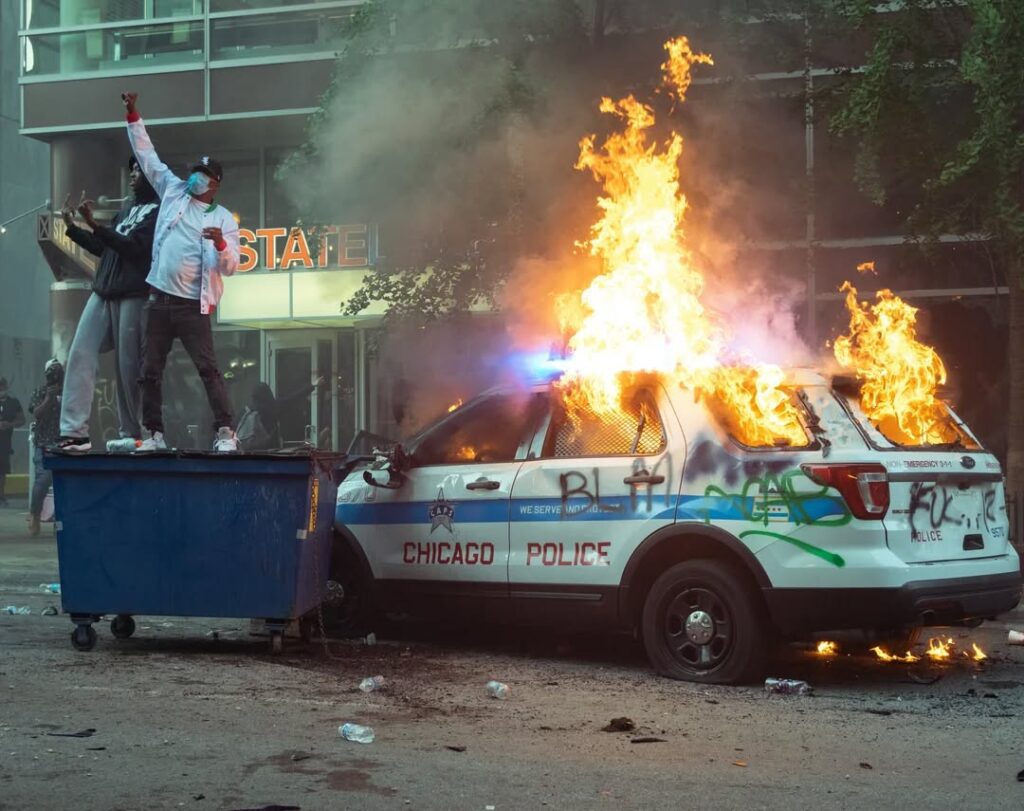
Chicago Police SUV burning in the Loop during the May 30, 2020 unrest following the death of George Floyd
Proactive policing was sidelined. Stops and arrests collapsed. Specialized units were gutted or restrained.
Officers were told—formally and informally—to disengage.
The message was clear: avoid contact, avoid headlines, avoid accountability.
Working-class neighborhoods absorbed the violence while downtown was selectively protected when money or optics demanded it.
This didn’t happen by accident. It was policy. It was politics.
And it was enforced from the top down—by a mayor’s office, a compliant City Council, and police brass more concerned with narrative management than street reality.
Now, years later, the same people who oversaw the pullback are pointing to narrow, cherry-picked declines and declaring victory—without acknowledging the surge they helped create, the lives disrupted, or the trust destroyed.
That’s not public safety. That’s managed decline followed by narrative laundering, and Chicagoans are expected to forget the damage and applaud the spin.
What they now call a “decline” isn’t progress—it’s a partial return to where crime should have been all along.
After years of artificially suppressed enforcement, chaotic streets, and policy-driven spikes, violence easing off its peak is being sold as success.
It isn’t. It’s normalization after damage.
Crime falling from an elevated, policy-induced high back toward historical baselines doesn’t erase the years of disorder, the lost businesses, the empty transit platforms, or the families who absorbed the cost while officials experimented.
While crime has generally declined nationwide, Chicago’s pattern reflects recovery from an unusually severe, policy-driven surge—not a model of successful reform.
Chicago isn’t safer than it should be—it’s still paying to get back to where it never should have left.
The mass-shooting data alone destroys the victory narrative.
In 2025, Chicago didn’t just continue to lead the country in mass shootings—it produced some of the worst ones.
Large-scale shooting events remained frequent, concentrated, and devastating even as officials highlighted selective declines elsewhere.
You don’t get to declare success while still hosting the nation’s most severe mass-casualty gun violence.
Averages and trend lines can be massaged. Crime scenes cannot.
This isn’t reform—it’s statistical camouflage.
As the data settles over the coming weeks, we’ll report in detail on where violence and crime in Chicago actually increased—what categories rose, where it concentrated, and who paid the price—after the spin fades and the numbers can no longer be manipulated to tell a winning story.
Cops will never say they did nothing—even when politics made doing nothing the policy.